Fish on Coins
Rare but meaningful, fish on coins reflect centuries of symbolism, culture, and design.
We live on a planet that is covered by approximately 71 percent water, with the vast majority being saltwater in oceans, the lifeblood of everything alive here on planet Earth. Carl Sagan called our home “the pale blue dot, which is the only known place in the universe, as far as we know, where there is complex biology. In these vast oceans, seas, rivers, lakes, and streams, there are about 242,000 known marine species and an estimated 1 million total aquatic species, including both marine and freshwater animals that thrive there. It has been noted that humanity has explored more of outer space than it has of these immense and numerous bodies of water. Scientists are discovering 2000 new species of aquatic life every year. With these recent discoveries, research organizations like The Ocean Census Project estimate that we have discovered only about 10 percent of all marine species to date, and that 95 percent of the world’s oceans remain unexplored, leaving most of their inhabitants undiscovered. Scientists further estimate that 94 percent of all life on Earth exists below water. With significant research and scientific studies, many discoveries are likely to occur at a “significantly accelerated” rate. Perhaps one day, while looking extra hard, they will discover that elusive Loch Ness Monster located in Loch Ness, Scotland, or they might actually find a real mermaid, but that might be another story at another time, for a different publication other than Numismatic News.
Fish are aquatic, gill-bearing, cold-blooded vertebrates with fins and tails for swimming and covered in scales. Recently, a few new species have been identified as warm-blooded. They are a very diverse group of animals, with many thousands of species found in fresh, brackish, and saltwater environments. Colors can range from demure silver or brown to beautiful blues and greens to multiple vibrant color variations across the rainbow. Fish come in all sizes, from the largest fish in the world, the Whale Shark, which can grow up to 50 feet or more, to the smallest, the Paedocypris Progenetica, which measures a mere .31 inches. The diversity of these aquatic creatures is immense and almost unimaginable.
I have always found sea life and sea creatures quite fascinating. One of my favorite pastimes is visiting an aquarium to view all the interesting and often fascinating sea creatures. As an artist who creates primarily aquatic art, I love producing colorful drawings of beautiful fish, both realistic and abstract. As a lifelong numismatist, I enjoy looking at and studying all types of coins, and I always get intrigued when I see something interesting and different in unique artwork. My curiosity “piqued” when I realized that many coins pictured all sorts of marine animals and fish engraved on these small discs we call coins. While exploring this area of numismatics, I recently discovered that I had thought there were many coins depicting sea life and fish. In fact, after further research, I learned that fewer than 10 percent of all coins minted worldwide depict an animal, and only a fraction of those feature a fish, meaning the percentage of all world coins with a fish pictured on their surface is even lower.
So, you may ask, why are fish depicted on coins at all? What is the significance of placing an image of a fish or other aquatic animal when countries worldwide employ numerous artists, engravers, and minters to do just that? One of the reasons is that, in a world filled with such a vast variety of animals that inhabit the land, sky, and sea, fish are perhaps one of the most important creatures on the planet. They are vital because they are a crucial source of food for billions worldwide, support global economies, and are essential for balancing marine ecosystems. In short, fish and the like are one of our primary sources of nourishment and are usually pretty healthy. Personally, I love a good piece of freshly caught flounder or catfish baked in the oven with lemon and butter, sprinkled with paprika and a little salt and pepper, and served with white rice. I figured I would mention that, but somehow I didn’t think it had anything to do with why most countries place fish imagery on coins. I just wanted to see if you were paying attention. Further studies show that economic drivers, such as fisheries and related industries, support the livelihoods of millions of people worldwide. In the pharmaceutical industry, the diversity of marine life, including fish, offers potential for discoveries.
Fish on coins also symbolize prosperity and good fortune. In Chinese culture, the word for fish sounds like the word for surplus or abundance, which symbolizes good fortune. In various cultures, fish are seen as symbols of prosperity and fertility. In some parts of West African culture, the sawfish symbolizes the power and authority of leaders in coastal communities. In Christianity, the fish symbol, or Ichthys, represents Jesus Christ, Son and Savior, and was used by early Christians during times of persecution. Fish have also been used as heraldic symbols, such as the herring, which were historically used to feed armies. In modern times, commemorative coins may feature fish to celebrate the beauty and diversity of marine life in the form of high-quality Numismatic art. Thousands of years ago, in ancient times, coins depicted mythological sea creatures, such as Amphitrite, Queen of the Sea. Also, during those times, their cities and colonies developed along the shores, rivers, and oceans, and relied heavily on these bodies of water for trade and sustenance. Subsequently, this led to fish becoming prominent symbols on their coinage.
Now that we understand a little bit more about why fish are depicted on different coins, here are just a few examples of aquatic life “enhancing” coinage throughout history.
Here are some of the more interesting examples of Ancient coins.
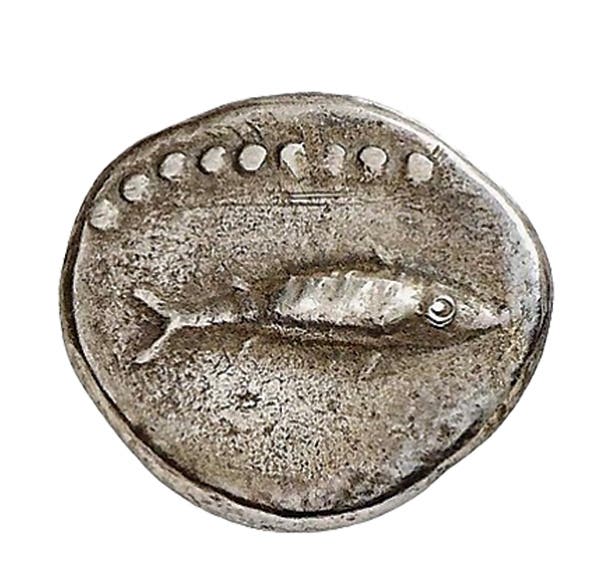
In Cyzicus, the Greek City on the Sea of Marmara, a Tunny Fish was depicted as its civic emblem as early as 600 B.C., highlighting the fish most commonly caught and its importance to the city’s economy.
The Ionian city of Phocaea featured a seal on its coinage. An early electrum coin (hekte) displays three seals swimming around a central pellet.
The Greek city of Akragas, in Sicily, featured a crab on its coinage, and in some cases it was accompanied by a fish on its silver tetradrachms.
Bronze pieces from Byzantium, issued during the Roman period, showed two tunny fish.
Sicily had another “Greek” city, Zancle, which depicted a dolphin leaping out of the water in its sickle-shaped harbor.
Between 480 and 440 B.C., the Dynasts of Lycia produced a silver Lycian Drachm fish coin depicting an unnamed species swimming to the right. The hammered technique used to make these coins created an irregular shape. I point this specimen out because I like its simple design and unusual appearance.
China produced ancient forms of currency during the Warring States period (770-221 B.C.), including “fish money” made of almost pure copper.
In Roman Egypt, Alexandria, large bronze drachmas were issued under Emperor Antoninus Pius that featured the constellation Pisces, represented by two fish.
There are many more examples of fish and other aquatic creatures depicted on ancient coins throughout time and history. One has to do a little research, if interested in this type of coin, to discover all the different varieties and examples of these wonderful and interesting pieces.
In addition to fish depicted on Ancient coins, aquatic life images can be found on coinage in many countries around the world. From simple designs with little detail to extravagant, exquisite works of art, everything imaginable can be found in interesting pieces from around the world.
Swimming forward to more current examples of “fish on coins”, research indicates that it’s impossible to identify the single “first” modern coin depicting a fish. It is believed that one of the earliest known examples is the 1928 Irish Florin, which prominently featured an Atlantic salmon, symbolizing the country’s vital fishing industry. This salmon design coin was so popular that it was carried over to another coin, the 10 pence piece, in 1969. The early 1960s saw a swift rise in new coins from countries like the Bahamas that featured fish as part of their national identity and for special occasions.
When the Bahamas decimalized its currency in 1966, a large blue marlin was added to its 50-cent coin, symbolizing the popular local sport of catching that unique fish. That design lasted three decades, and many citizens and tourists adored it, with many vacationers keeping one or two as souvenirs. As a collector and artist, I love the artwork and simplicity of this piece.
Barbados released a “flying fish dollar coin” in 1973. It was a proof dollar coin featuring that fish, it’s the National symbol.
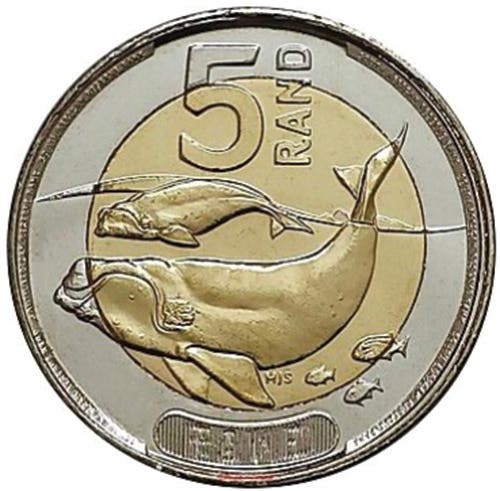
South Africa has an interesting bimetallic 5 Rand coin with a brass center set in a copper-nickel ring. This standard circulating coin was issued in 1961 and is still in circulation today. The reverse shows southern right whales with a school of galjoen swimming left.
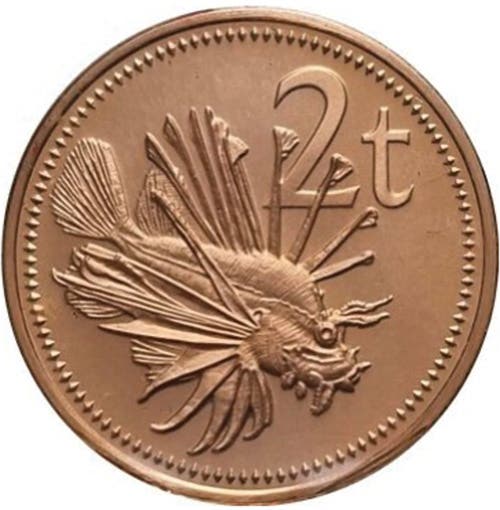
Papua New Guinea produced an interesting bronze piece from 1975 to 2004. This 2 Toea piece features a lionfish on its reverse and is displayed in a very distinctive manner. This “Scorpion” or Lion fish can be found in the reefs around that area.
In 1932, a standard circulated 5 Pfennigs fish coin made of aluminum bronze featured, on its reverse, a Turbot fish swimming to the right. A basic design that features a rather plain-looking and ugly fish, that may indeed taste good, “the fish, not the coin,” in my opinion, makes for an equally ugly coin.
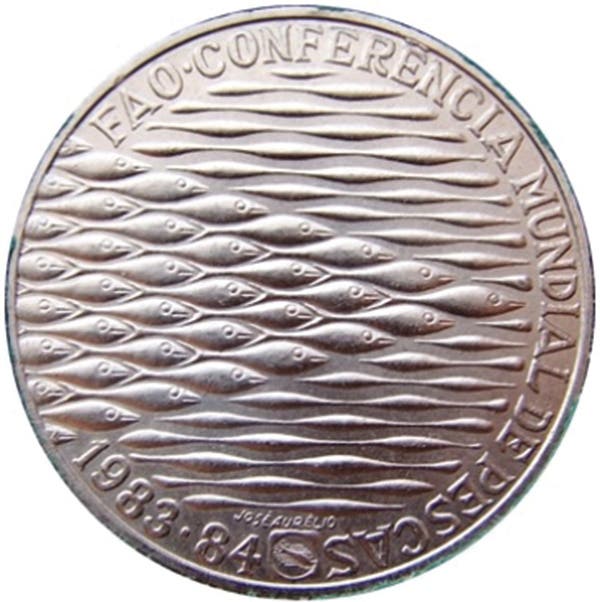
Portuguese coins often feature seascapes and ships, and more often fish due to the country’s deep connection with the Atlantic Ocean. This country introduced a rather interesting circulating commemorative coin in 1984. This 250 Escudo piece is composed of copper-nickel. As an aquatic artist, I find the particular piece intriguing and very interesting. On the reverse, a cluster of the same small fish within a triangular design is facing right, making it different from other fish coins. To me, it looks more like a “modern” “art deco” piece.
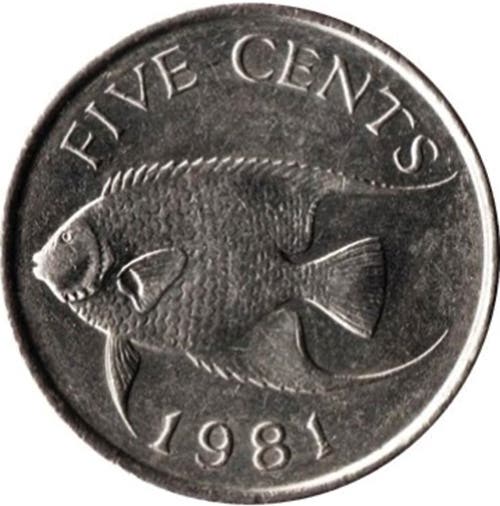
Bermuda is no stranger to producing a wide range of coins featuring all sorts of tropical land and sea life. I have to include their simple yet elegant 5-cent piece that depicts a Queen Angelfish on its reverse, facing left. Minted from 1970 to 1985, this copper-nickel little gem stands the test of time and is a personal favorite of mine for its simplicity and lovely artwork.
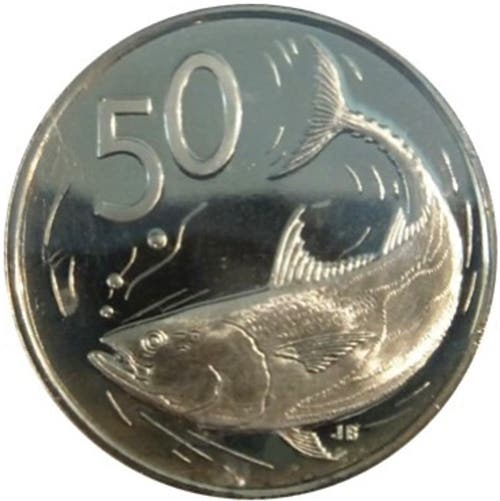
The Cook Islands have also created many thoughtful and engaging pieces for both circulating and non-circulating issues. The 50-cent piece minted between 1972 and 1983 is no exception. This “fish coin”, minted in copper-nickel, displays on its reverse a Bonito fish placed in the lower right with its tail facing upward. I enjoy how this fast-moving fish seems to move along rather quickly yet elegantly on an exciting coin.
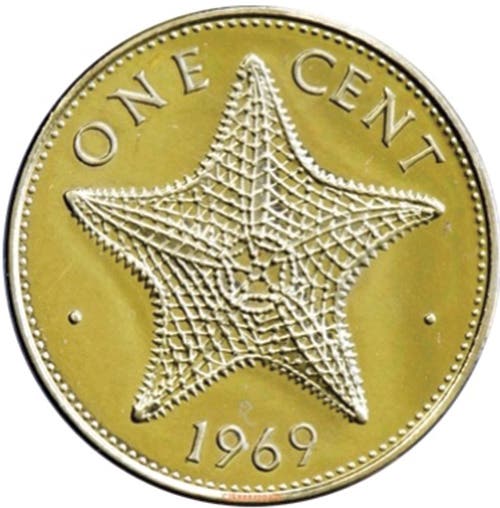
The Bahamas issued a beautiful little one-cent piece featuring a starfish for standard circulation between 1966 and 1969. Made of nickel, brass, copper, and zinc, its unique coloration makes it stand out from other pennies, especially a new or uncirculated piece. The reverse of this coin exhibits a top view of a starfish with an interesting, intricate design. One of the first foreign coins I ever owned, and I still have it today.
Iceland has issued the Icelandic krona, which famously features various marine life: a cod on the 1-krona coin, dolphins on the 5-krona coin, and capelins on the 10-krona coin.
The Commonwealth of Gibraltar proudly features dolphins on some of its coins because they are common in the waters around the territory and have high public appeal. Considered one of the most intelligent animals on earth, these creatures grace many different coins all over the region.
The Maldives minted a 5-rufiyaa coin in 1977 that pictured a bonito fish as part of the “Grow More Food” program.
In 1998, the Isle of Man issued a crown coin depicting a basking shark to celebrate the Year of the Ocean.
Cyprus issued a 500-mil coin showing a fearless swordfish.
In 2009, Fiji minted a new colorized dollar coin featuring a fish. It’s an exciting piece.
Right here, in the good old U.S.A., we have a wonderful assortment of coins produced throughout our 249-year history, covering many different interesting subjects and themes. As far as fish or aquatic life are concerned, depiction on our coins is almost non-existent. The exception is our State Quarter Program, which introduced two coins featuring fish on their designs. In 2007, the Washington quarter depicted a king salmon leaping in front of Mount Rainier, and the Alaska quarter of 2008 features a grizzly bear clutching a salmon as he emerges from the rapids. Although the fish on the latter coin mentioned is relatively small, it’s still a fish, and I am sure the grizzly had a nice dinner, despite not having butter and lemon juice to enhance its flavor.
In San Marino, a 1975 50-lira coin featured a salmon to symbolize “love for one’s native country,” depicting the fish swimming upstream to its birthplace.
Modern-day issues that featured fish:
Niue is a small island nation located in the South Pacific Ocean. In 2024, it featured the CREATURES OF THE ABYSS series of coins, including a Deep Sea Fish $10 5 Oz Silver Black proof, with a mintage of only 350 coins. In my opinion, this is a truly amazing, engaging, and beautiful piece that looks more like a sculpture than a coin. With its unique dark background, this coin is truly striking.
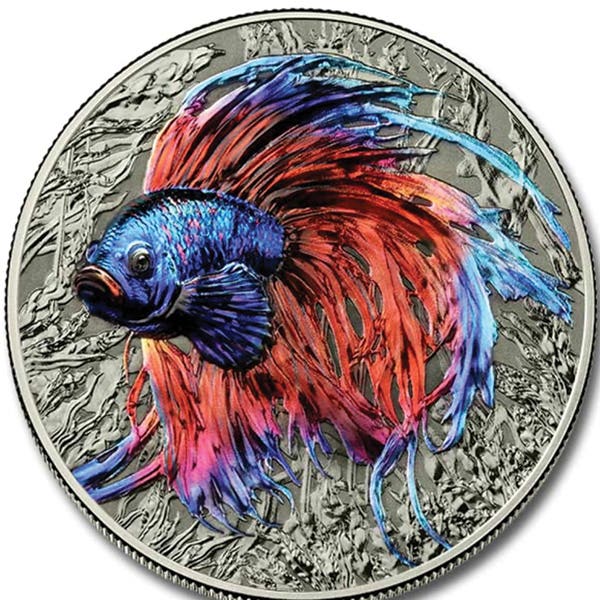
Also in 2024, Niue produced a truly remarkable and quite exquisite 2 oz high-relief $5 silver piece depicting a vibrant Betta Fish with its iconic flowing tail, with vivid details on its obverse. Betta fish are known for their variety of beautiful, vivid colors and are often associated with determination and vitality. With only 500 coins minted, it would be a nice addition to have in a collection for its beauty and rarity.
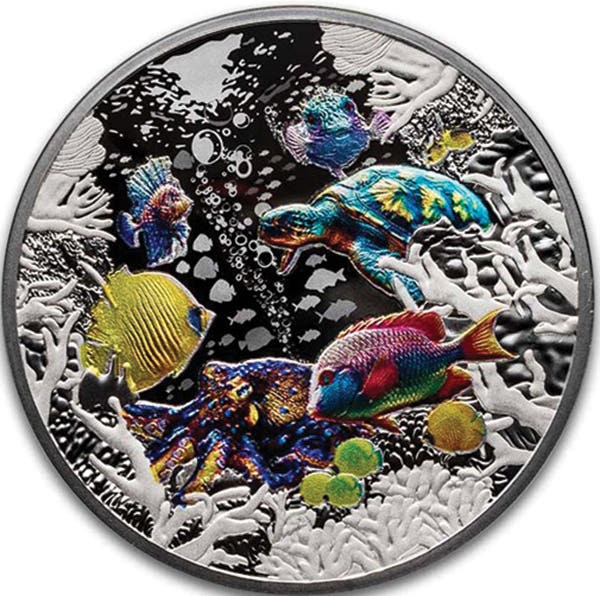
In 2025, the Mint of Poland, which has been in operation for over 250 years and is one of the world’s most technologically advanced mints, struck 500 1 oz pure silver coins for Niue. The gorgeous piece depicts several colorful fish, an octopus, and a turtle swimming amid coral reefs. With a frosted coral background surrounding a rainbow of colorful aquatic creatures, this is a fantastic, stunning work of art.
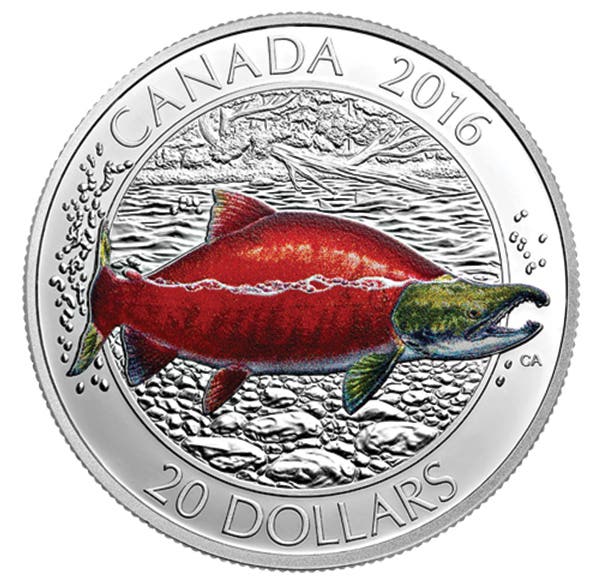
In 2016, Canada produced a 1-oz pure silver-colored coin, marking the end of its Big Fish Series. It has a face value of $20 and is finished in proof condition with a mintage of 5,500 pieces. This coin featured a Sockeye Salmon, an indigenous species of large fish with distinctive coloration that beautifully enhanced the engraved portrait of this fish migrating upstream. The coin’s 40-mm size provides a larger canvas, allowing for more detail. For people who collect Canadian pieces, or fish coins, this is one to behold; it’s a very remarkable coin.
The Republic of Cameroon is no exception, producing another fantastic piece of aquatic art on an original coin featuring a goldfish. Produced by the Mint of Poland, it features, on its reverse, a goldfish magnified by a lens covering the image. The coin contains 0.56 oz of fine silver, has a low mintage of 999, and has a face value of 500 francs. I personally find this fish coin exciting and unique. It is very different and would be a nice addition to a fish coin collection.
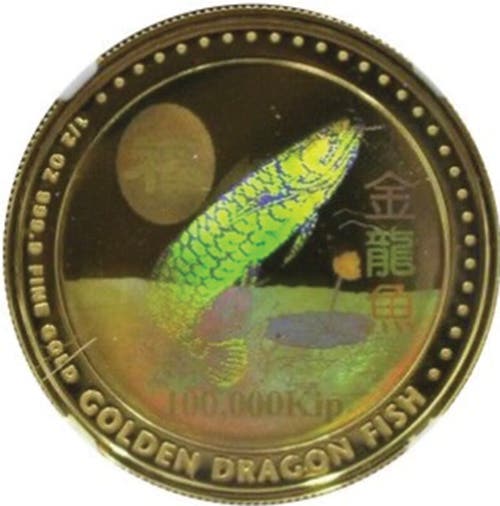
A hologram of Golden Dragon Fish is displayed on a 2001 Non-Circulating coin from Laos. This proof addition has a multicolored holographic jumping fish leaping out of the water. Its composition is .9999 gold and weighs 15.55 g. It’s a glimmering coin that shimmers as you hold it and move it around in your hand. If you are a fish coin collector, a gold coin collector, or a hologram coin collector, this one would fit into any of your coin collector categories.
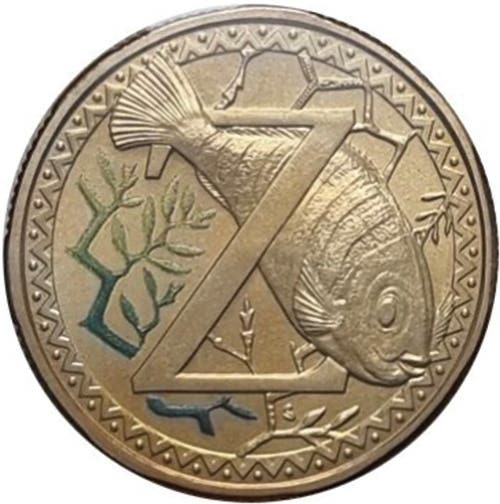
Australia introduced a brilliant series of commemorative coins named the “Alphabet Collection Series”. These coins are part of a series dated 2015-2017 and are frosted and “partially” colored. There are 26 coins, each produced in both silver and aluminum bronze. These coins were meant to capture the love of Australian animals and the alphabet. The fine silver proof version of each coin was issued with a plush case. The less expensive aluminum-bronze coins can be collected individually or purchased as a Baby Mint Set. What a fantastic way to introduce a young child to the world of coin collection, this would be. Featuring an assortment of land, sky, and sea animals throughout the series, a few of the coins featured aquatic life. The commemorative S lettered coin features the seahorse, playing and interacting with the upper-case letter S. This fun, intricate, and elegant design makes for a unique and wonderful aquatic piece of art and a great addition to an aquatic coin collection. The 26th letter of the alphabet is Z, so the reverse of this coin depicts the letter Z with a Zebra Fish playfully interacting with it. Solid craftsmanship and attention to detail on the fish and its surroundings make this another great design and overall fun coin.
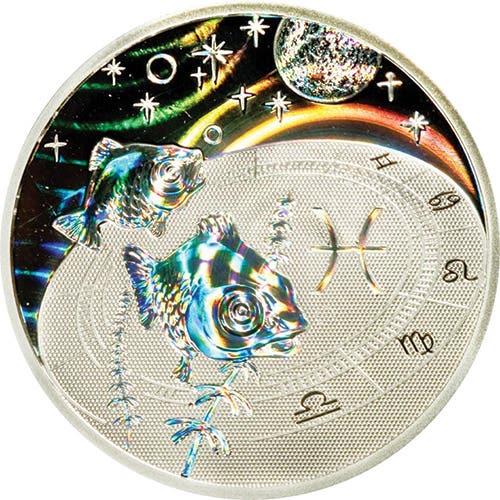
In 2010, the Republic of Cameroon minted a non-circulating silver coin featuring two right-facing fish on a disc with zodiac signs. The 500 Francs coin has a bit of holographic imagery that enhances this fish, making them “pop” as they appear to try to swim off the coin.
Exceptional Modern-Day Coin Designs:
As you can see, I am pretty fond of fish and aquatic life depicted on coins, as well as producing colorful artwork featuring these beautiful creatures. I have mentioned a considerable number of these coins, which, in my opinion, are quite historical and interesting, but may lack in great artistry. However, I would like to note that there are a few coins that I have found in this category that I consider to be of exceptional quality and of extraordinary design.
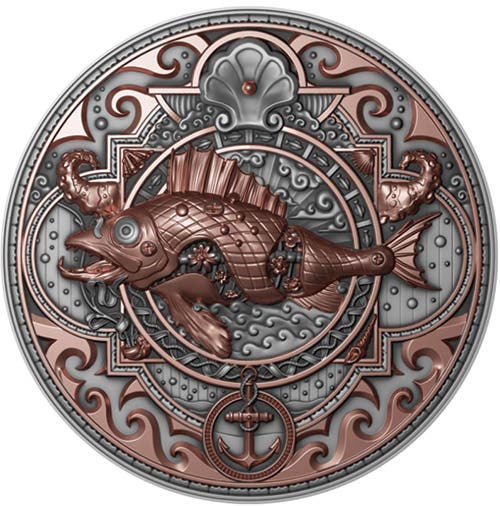
In 2022, Niue, a self-governing island nation in the South Pacific, produced a very unique and unusual “fish coin” which showcased its artwork as a Steampunk Metal Fish with a $5 NZD value. This very creative and unusual specimen is produced in high relief with a remarkable copper-plated steampunk fish on its reverse. It’s silver, weighs 62.2 g, and is large, measuring 50 mm in diameter. A great artsy piece, especially if you like steampunk as I do.
The Barbados 1-dollar coin, minted in 2020 and launched virtually in November of that year, is a limited-edition circulating coin made of a base metal. The piece highlights Barbados’ iconic one-dollar “Flying Fish” design with the mint’s new “glow-in-the-dark painted technology. The unusual minting process features a simple blue-and-white fish design and shines when the lights are turned off. Just make sure you are the one holding it, or it might magically disappear! These pieces entered general circulation with a mintage of 1 million.
This year, 2025, Canada, once again, being one of the world leaders in innovative coin designs, minted a one-ounce silver coin, its PISCES piece, the eighth of a series called “Stone Zodiac”. This intriguing piece features a very nice colorization in wonderful shades of blue and aqua, with touches of red. Not many people can own such a piece, as it had a worldwide mintage of only 100. This is a great piece, beautifully done.
This may sound “just a little fishy,” but last and not least, I would like to talk about what I consider a truly magnificent specimen of aquatic art on coins. This incredible piece will receive a complete description and review, because, as an artist and coin enthusiast, I find it most inspiring and enjoy critiquing the artistry of coins. In 2024, the island of Niue minted one of the most truly remarkable coins. The stunning 5 Oz Silver Proof, measuring 65 mm in diameter and named Creatures of the Abyss, was produced using a “new” deep-black gradient color technology. This $10 NZD collector piece is considered truly rare, with a worldwide mintage of only 350. It features a veritable gallery of creepy deep-sea monster fish that reside between 1000 and 5000 feet deep, where no light reaches the pitch-black depths of the ocean. While an anglerfish lights up the surrounding area with its bioluminescent “fishing rod”, other deepwater creatures like the Lanternfish, Fangtooth, Viperfish, and Hatchetfish seem to enjoy the light provided by their unique friend. This super beautiful piece is meticulously and realistically rendered, and the engraving is so detailed that you can spot the individual scales of each exquisite fish. One masterful piece I would like to own, just for the majestic artwork. If you ever have the chance to view one in person, please do; I know you will enjoy seeing it.
So there we have just some of the coins that depict aquatic art and fish on their surface. And some fascinating history that goes along with them. Although the number of pieces that display these animals is limited, there are many examples to find and collect. From common coins used for currency to exotic and beautiful commemoratives, there are enough fish coins for everyone to enjoy. Just don’t eat them, that’s probably bad for your health; consume real fish instead!
You may also like:

 Philip Lo Presti grew up on Long Island, New York, is retired, and now lives in Florida. His interest in coins was sparked by a Canadian coin he received in spare change at the ripe old age of 6. The different look of that coin spurred him on to study and collect coins for the next 61 years. His relationship with Numismatic News began with contributions to “Letters to the Editor” and the “Viewpoint” sections of the publication. His viewpoint critiquing the artistry of the newly released state quarter program attracted the attention of the editor at the time, who published it as a two-part feature series. He now enjoys writing articles regularly. He is a lifelong artist and photographer as well as a numismatist and brings his eye for artistry, beauty, and craftsmanship to his impressions and interpretations of coins. He combines these with a little bit of coin history to create interesting, informative, unique, and often witty articles. He loves and values the responses to his articles and hopes to hear from more readers in the future!