Beyond the Mainstream: The Eisenhower Dollars Hiding In Plain Sight
It’s tough to find a series of United States coins in which there is some silver, but which also have some good prices nestled in among the greater bunch. What…
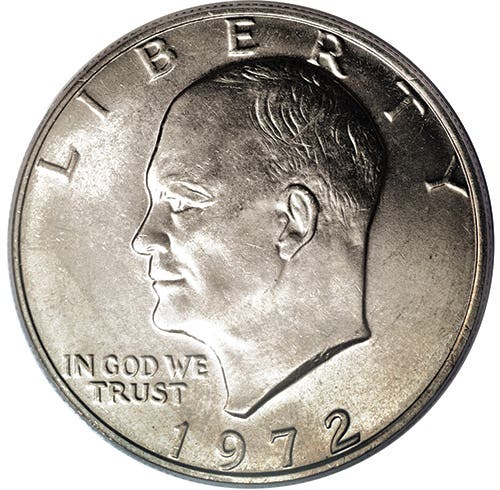
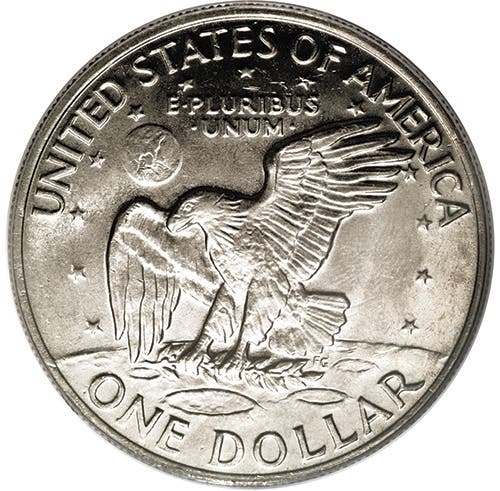
It’s tough to find a series of United States coins in which there is some silver, but which also have some good prices nestled in among the greater bunch. What we call classic United States silver seems tightly entwined with the volatile jumps that silver has made in the world’s markets of late. But there is one series, the entire run of which is often overlooked by collectors, in which we can find both base metal coins and pieces with the precious metal within them, a series that could be fun to collect. We’re talking about the Eisenhower silver dollars.
Background, likes, and dislikes
Since it has been almost fifty years since the last of the Eisenhower dollars was coined, collector opinions – what can be called likes and dislikes – have become rather ingrained. Folks who do like this series tend to do so because these dollars represent the last coins that have a silver dollar’s size and heft in the hand. Those who dislike the series continue to point out that the artwork of one more presidential portrait simply does not measure up to the Morgan and Peace dollars that came before. We won’t make a judgment call either way, but will say that ugly or not, this series does have some neat possibilities within it, be they in base or precious metal.
The common, base metal pieces
Let’s start out with the base metal coins among the Eisenhower dollars. Minted from 1971 to 1978, the circulating pieces in this series will probably be common for the next thousand years based on how many were produced. The 1922 Peace dollar had ruled that roost for decades, with just over 51.7 million to its official tally. In 1971, it was the branch Mint in Denver that smashed that mark, coming in with over 68.5 million. Add another 47.9 million from the main Mint in Philadelphia, and it certainly will never be hard to find one sporting this date.
The following years continued to see enormous mintages, which translates into wonderfully affordable prices today. Indeed, while mint state specimens don’t cost all that much – unless we opt for the best of possible mint state grades – if we actually wanted to go to incredibly inexpensive levels, why not try something like an AU-55 example? Even a little bit of wear on one of these big guns brings the price down to something like $5. Really.
Where the silver can be found
We’ve ignored the ‘S’ marked coins thus far, but that is simply because this is where all the silver is concentrated, and it deserves some special treatment. It may seem odd today that the decision was made back then to produce proof and uncirculated coins for sets with only 40 percent silver in them. But we should remember that this was a precedent already set in 1965 when the silver was removed from dimes and quarters, but reduced to 40 percent for half dollars. From 1965 to 1970, the Kennedy halves were the final hurrah for silver in any of our then-circulating coins. Or so we thought back then. For the Eisenhower dollars, this reduced silver amount would persist through the dual-dated pieces of 1975 and 1976.
Each of these silver Ikes (as they are often called) has 0.3161 ounces of the metal in it, and so we can make some estimates for how much one has to cost, based just on that. When silver trades at $70 per ounce, which it has in the recent past, there is a bit more than $22 of it in each of these big dollars. That’s worth remembering if we opt to see if we can land a 1971-S in something like MS-65 – or any of the other ‘S’ marked silver coins, for that matter. We might be pleasantly surprised by how close their prices are to the spot value of silver metal. As well, since the final two years of the series saw ‘S’ marked coins with no silver in them at all, those two coins are basically as cheap as all the other base metal dates and mint marks.
That one commemorative, and those “high relief Earth”
We just mentioned the dual-dated Eisenhower dollar, one of three denominations that was used to commemorate our nation’s bicentennial, even when Congress had not authorized any other commemorative coins for decades. There are a couple of varieties for this piece, based on the style of the reverse lettering, and only the Philadelphia piece with what are called bold letters commands any sort of premium. Unless a person is trying to assemble an absolutely complete set of these dollar coins, that expensive one is often omitted from the group. While it’s a neat variety, plenty of collectors don’t feel the need for the added expense.
Another variety that came to light only after some time had passed, and the Eisenhowers were no longer being minted, is what is called the “high relief Earth” pieces. It is difficult to determine for certain how many of this variety were ever coined, but few enough of them have been recorded or encapsulated that today it will cost at least $100 to land on in the lower grades of mint state. As to truly high grades, such as MS-66, well, the price of a high relief Earth specimen like that is truly out of this world, bad pun intended.
Back in the mainstream?
The reasonable prices for most of the Eisenhower dollars that have been made are a neat perk of the series. Yet even these numbers don’t seem to be enough to drag this group of silver dollars back into the mainstream for most of the silver dollar collectors out there. That being said, now is probably a good time to gaze carefully at this oft-overlooked series and see if we might take some pleasure in putting a set together for ourselves.
You may also like: