Bargain Collector: The 1988 and 1989 Commemorative Silver Dollars
Even with silver prices soaring, a closer look at early modern commemorative issues shows that attractive U.S. silver dollars from the late 1980s remain surprisingly affordable.
Right now, as the price of silver climbs to heights that many collectors thought would never be seen, it’s tough to believe that there might still be bargains among any United States coins that are made of the precious metal. Certainly, the price tags associated with common date Morgan and Peace dollars have jumped up. Likewise with the popular Walking Liberty and Franklin half dollars. Long-time collectors are most likely grumbling and telling plenty of “back-in-my-day” stories about some time of far better prices. Alas, those days are gone, completely and totally. But in the midst of all this, we’ll make the claim that there are still a couple of bargains a person might be able to hunt down when it comes to good-looking silver dollars.
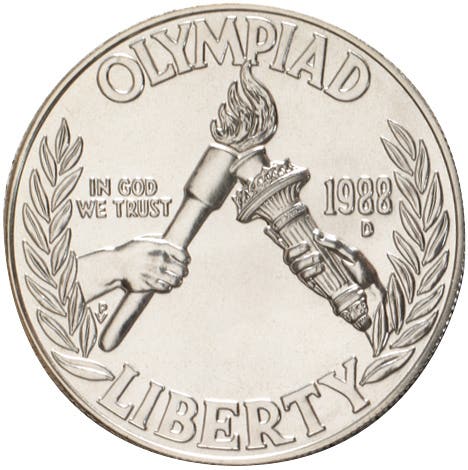
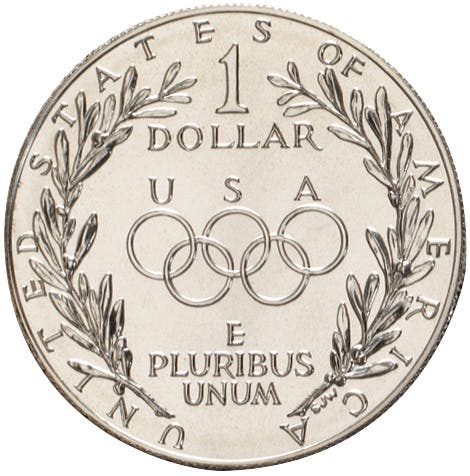
The 1988 Seoul Olympiad silver dollar
For those of us in the collector community who remember the rebirth of our commemorative coinage program in the 1980s, the two-coin set honoring our participation in the Olympic Games in Seoul, South Korea, is pretty much remembered for…nothing. That may sound harsh, but really, this duo honored a set of Games that we were not hosting. Coming as it did after the successful Statue of Liberty centennial coin set and the Constitution bicentennial duo, many collectors felt they were just being milked for cash, even though they admitted the Nike design on the $5 gold piece was stunning. Being milked for cash did translate to some mintages that were much lower than those that came before. And that in turn might translate into reasonable prices today.
As we routinely do, let’s find a base price for this coin and see what sort of mintage totals we are looking at. There is 0.7734 ounces of silver in each of these, like the classic silver dollars long before them. When silver trades at $60 per ounce, that means there is $46.40 of the precious metal in each one. So that is our rock bottom price – one that still probably seems rather high to those of us who have tracked precious metal prices for any length of time.
When it comes to official totals for any coin, this silver dollar was one of the early ones to see what can be called an inverted production. What we mean is that since people could order directly from the Mint, most folks opted for proof specimens – 1,359,366 of them were made, all tallied – and not as many opted for the uncirculated version – only 191,368. Usually, proofs are the scarcer of the two grades, or at least, they routinely had been when comparing circulating coins to proof sets.
Where this difference in proofs and uncirculated pieces gets interesting is in the prices. They are virtually the same. Even though the uncirculated 1988 Olympic dollar saw less than 20 percent of the output that the proof did, it costs about the same. And checking price lists and the “Wild West” that is eBay, this is about $60-$80. Not bad, really.
For the collector who is also a speculator, meaning someone who plans to buy and sell quickly, making a profit in the process, the chances are slim that this coin is going to jump up in price in a short period of time. Yes, it is far less common than the key coins to a series – such as the 484,000 pieces that are the whole of the 1909-S VDB Lincoln cents – but is not a necessary purchase to complete a series. Most collectors of the modern commems choose a single example of each coin, not one of each condition. So it is likely that these silver dollars will remain at their current prices for quite a while, and continue to be bargains.
The 1989 Bicentennial of Congress silver dollar
The 1988 Olympics coins saw the issue of a trio of commemorative pieces, all honoring the Bicentennial of Congress. There was a base metal half dollar, the silver dollar we are looking at, and a $5 half eagle gold piece. The overall production continued to drop, possibly because people had seen that listed values for the earlier commemorative issues had dipped with the passage of just a little time, and with the coins’ growing presence on the secondary market. There may have been other reasons as well. Whatever the case, though, the total number of this uncirculated 1989 silver dollar had dropped to 135,203 pieces, and their proof siblings came in at a much larger 762,198 examples. Comparing both of these to the just-mentioned 1988 Olympic silver dollars, though, we see that these represent two data points where the overall mintages decreased.
Curiously, while overall mintages went down, prices have not really gone up. An uncirculated example of the 1989 Bicentennial of Congress silver dollar still rings in at about the same cost as the uncirculated 1988 Olympic dollar. Likewise with the proof versions. We’ll admit that if we choose to run down an MS-70 or PF-70 certified specimen, then the cost will be higher. But it’s not as if any of the raw coins are going to be ugly in any mint state grade, either as uncirculated or proof.
Are there more?
We’ve just seen that two of the silver dollars, which mark a couple of the early years of the modern commemorative coin series, are very reasonably priced. There are quite a few more silver dollars in this series, one that now spans close to four decades. It could be fun to chase down the silver dollar with the lowest mintage that has no higher price than the baseline. It could also be fun to see where the prices do jump, perhaps from grades such as PF-68 to PF-70. But for right now, it’s good to know that there are still some bargains among United States commemorative silver dollars.
You may also like: