Item of the Week: Some business strikes are better than proofs
Beyond the famous 1877 and 1909-S, early 1870s Indian Head cents and overlooked dates like 1876 are quietly revealing how survival rates, not just mintages, drive today’s market.
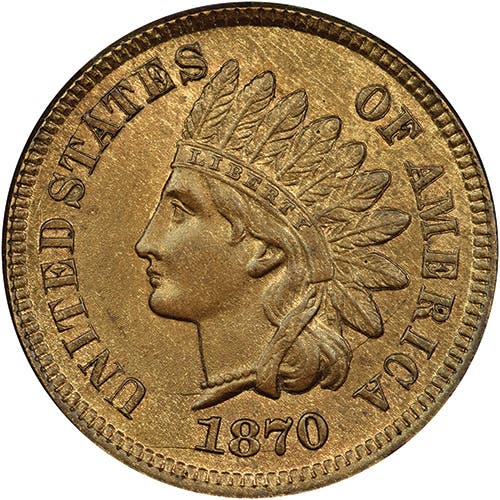
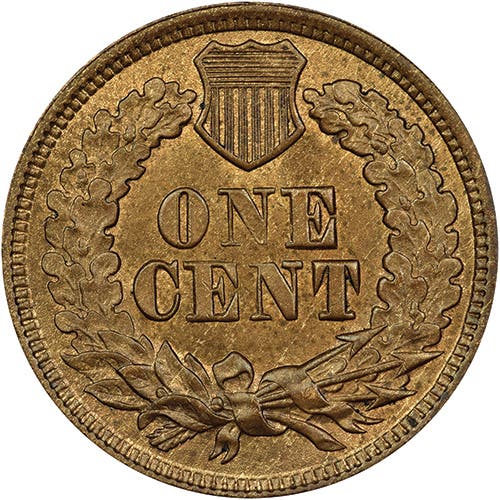
When it comes to Indian Head cents, everyone knows about the 1877. It has always been the key, even though its mintage of 852,500 is far higher than the 1909-S, which checks in at just 309,000. The 30 years between 1877 and 1909 apparently made a huge difference in how many were saved.
It does not take an advanced degree to figure out that the 1877 and even the 1909-S are good dates. The mintages alone solve that. Some of the other better Indian cents are not so obvious. The dates have basically gone according to their mintages in terms of lower grade prices, with only the low-mintage but also more recent 1908-S seemingly out of order. It, too, is more available than its mintage would suggest.
In upper grades, things have been evolving. The big evolution has been in top-grade business strikes. Dates from the early 1870s have really become the darlings of serious students. Their points are well taken. Back in the 1870s, collectors acquired just proof examples. Many did not collect by date and mintmark – the cent had no mintmark anyway, so it was actually quite logical.
They wanted a top-grade example for each year, so they acquired proofs. Proof mintage numbers tended to be about 1,000 pieces a year in the early 1870s. That gives us a pretty good indication of the level of collector interest at certain times. There were 1,000 proofs in 1870, but the number dropped to just 510 in 1877.
The current belief for the early 1870s dates is that much of the proof production survived. The business strike production, however, is another matter. A small number might have been saved, but very few. Moreover, the supplies of upper grade circulateds is also low, making it appear as though they were not saved quickly.
A new collector might pluck an 1872 from circulation, but there were not many new collectors in the 1870s. What is the result? Look at Coin Market. Some of the proofs are actually priced lower than MS-65 business strikes. That should tell us something.
Today, interest in the series is primarily in dates from the early 1870s. The slightly later dates, such as 1876, receive relatively little attention.
In fairness, the 1876 did have a mintage of 7,944,000 pieces, which was higher than dates like the 1870, 1871, or 1872. It is, however, lower than the 1873-1875 dates, and its price is slightly better than those dates in most grades.
The suspicion, however, is that the 1876 may well have some room for an additional increase in price, although it has not received the attention of the 1870-1872 dates.
If you look at the 1876, you see a proof production of just over 1,000 pieces. Its proof price today is as low as any date from 1859, with the exception of the 1873. Its uncirculated price is also low for dates of the period.
We actually have no way to be certain just what type of supplies of the 1876 remain. As we have learned from the dates from the early 1870s, what supplies there are can almost certainly be described as low compared to what we might expect.
Other dates may have received the lion’s share of the publicity and the substantial price increases, but there is plenty of reason to suspect that dates like the 1876 will also continue to do well, as any increase in demand at all seems to strain a supply made far smaller than normal by the circumstances of the time.
Images courtesy NGC.
You may also like: