Item of the Week: Are you ignoring 1880 three-cent pieces?
Collectors have long overlooked the 1880 three-cent piece, but its low mintage, affordability, and history make it one of the hobby’s most underappreciated copper-nickel coins.
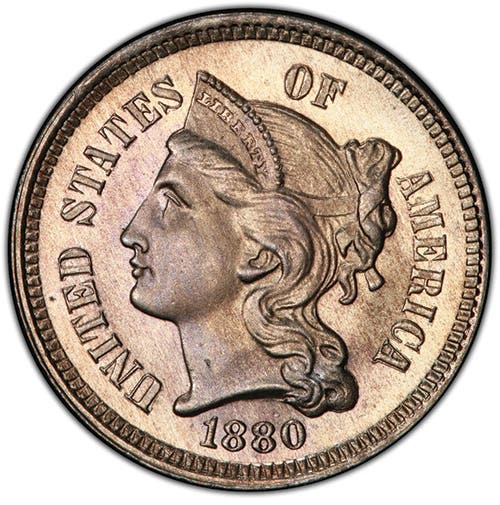
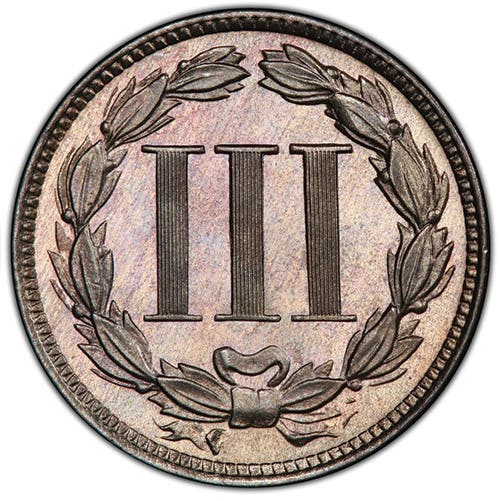
Apparently, few collect three-cent pieces, as that is the only possible reason for the price of the 1880 and other copper-nickel three-cent pieces. That’s a shame because people are missing great coins at bargain prices.
There was no good reason to have a three-cent piece. The best reason to be advanced is that the three-cent piece would make it easier to buy stamps. That idea is about as good as the idea that the first three-cent pieces used more silver. There may be elements of truth in both, but they may be modern ways of explaining something we do not understand. There was not a huge surplus of silver, and people did not stand in long lines to buy stamps in the 1850s.
The stamp idea may have a bit of truth, for there is reason to believe the public was tired of large cents and half cents. People might not have been in favor of three-cent coins, but they were hoping for something easier to carry. The first three-cent piece was partially silver, as it was feared the public would reject a coin that did not have a metallic value close to its face value.
There is no evidence that the three-cent piece was successful. Mintages after 1853 rarely reached 1 million. The denomination was probably in peril because of the Civil War, when it disappeared with other coins.
At the time, any coin would have been used, but lower denominations were needed to make change. Fractional Currency was one answer, but coins were better, so the composition of the cent was changed, a two-cent piece was created, and copper-nickel three-cent and five-cent pieces were struck.
By the 1870s, the silver three-cent piece was only in token production. It was last minted in 1873. The copper-nickel three-cent was doing better, although mintages rarely topped 1 million. For a few years, it experienced a drop in production. It started in 1877 with a proof-only production and continued through 1880 with a mintage of just 24,955. It was a tough economic period, and the Mint was busy creating silver dollars. The copper-nickel three-cent coin rebounded in 1881 when more than 1 million were produced, but like the silver version, it was on its last legs and was discontinued in 1890.
The low mintage of the 1880 would seem to make it the key date. There were, however, proof-only and regular dates that had even lower mintages.
Because the 1880 was not the key-date copper-nickel three-cent piece, plus the fact that few collect it, conditions exist to call it an overlooked coin.
Overlooking it is a mistake. In 1880, many collectors acquired a proof example of any coin needed each year. In the case of 1880, that proof mintage is 3,955 of the total mintage, making the proofs less expensive and more available than top-grade uncirculated examples.
But evidence suggests that the 1880 three-cent piece might have circulated heavily. After years of modest production in 1881, there was a mintage of over 1 million copper-nickel three-cent pieces, which strongly suggests that inventories were under pressure. Most of that mintage was likely pushed into circulation, making proof examples not only the most available and affordable 1880 three-cent pieces, but possibly the only 1880s available. That said, prices start at $100 in G-4 and rise to $950 in MS-65. That is a slight increase in the circulated price, but consider the age, the mintage, and what prices you would expect of similar-mintage modern issues, and the 1880 three-cent piece is a real bargain.
You may also like: