
Item of the Week: 1807 Quarter Eagle is an Example of Early Gold
Limited gold supplies and uneven circulation made early quarter eagles rare, with the 1807 Capped Bust issue standing out as a fleeting high point in production.
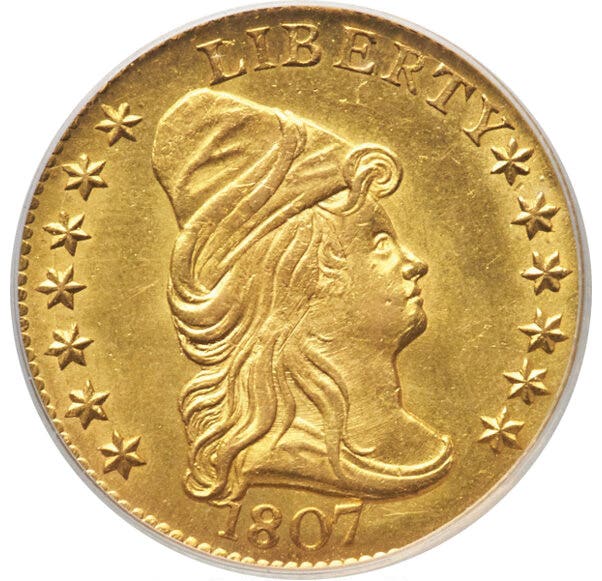
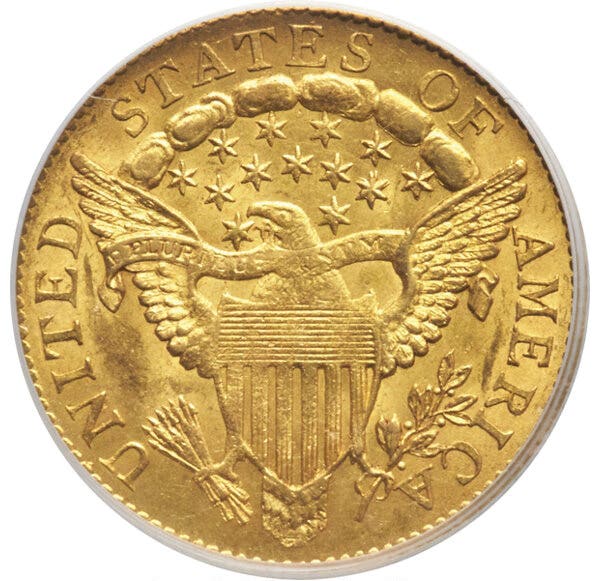
Coin for coin, there are few greater rarities than what are found in early American gold. Finding any early American gold coin is unusual, and that is especially true for the right-facing Capped Bust design that was discontinued after some production in 1807.
The annual mintages at the time would barely keep one of the current minting facilities busy for an hour.
While gold coins had been authorized in the original act creating coins of the United States, there was no provision as to just how those gold coins might be made. The United States had virtually no gold from which to make coins. There were no working gold mines. The first real supply of domestic gold would not be discovered for many years.
The situation with copper and silver was a little better. While copper was needed for a variety of reasons, the early Mint was able to produce some coins from tokens, and later was able to purchase needed copper from England.
In the case of silver, while there were no domestic mines, there were a number of domestic options. People would bring in silver in all forms to be melted down and exchanged for coins of the United States. It might be a fork here and some silver coins of England or Spain there, but at least it was silver that could be used in coinage.
The situation with gold was not so simple. The United States tended to be short of gold coins because gold was the metal of choice for paying for imports from Europe.
Because America imported more than it exported, the trade deficit kept the supply of gold under strain.
In the case of the early Mint, when someone did appear at the door with gold, they were basically allowed to determine what denomination of coins they would get for it. Most often, not unlike silver, they would request upper denominations.
For the country, this presented a problem. Upper denominations in both gold and silver were not circulating. That brought about the suspension of production of silver dollars and gold $10s in 1804. The hope was that smaller denominations would circulate.
In the case of gold, the suspension of eagle production did seem to result in a rise in the production levels of half eagles. In the case of quarter eagles, though, it made little difference.
Prior to 1804, the combined production for all years of gold quarter eagles stood at a less-than-whopping total of about 5,000 pieces. In 1804, another 3,327 were produced, a little less than 300 more than the 1802/1 production, but a record nonetheless if only by a few hundred.
In the years that followed production, levels slipped to under 2,000 pieces, but in 1807, apparently giddy customers had a staggering total of 6,812 gold quarter eagles produced. No one really knows why, but for the type collector, it was a bonanza. A few 1807 quarter eagles survived. In fact, a few of the 1807 quarter eagles actually survived in better grades, and they have what are slightly better than average strikes.
There is no reason for a major celebration. The 1807 quarter eagle is still a rare coin. Even in F-12, it is $8,450.
Obviously, the 1807 Turban Head quarter eagle is not for every collector. If, however, you happen to be one of the lucky ones who can even consider early gold, then the 1807 is probably the one date you can afford, or at least have a prayer of finding in the market.
You may also like: