The Evolution of Minting Technology–Part I
Beginning with the earliest coins of Lydia, this series explores how minting technology evolved from simple metal lumps into the structured coin production that defined ancient economies.
Photograph courtesy Wikimedia Commons.
Coins have been around since what seems like the dawn of time and human civilization. Of course, numismatists, collectors, and historians know this isn’t quite true. It is generally believed that coins as we know them began around 700 B.C. in Lydia (modern-day Turkey). Some simple questions arise from this, such as how coins were made, who made them, and how they managed to keep up with demand.
These early coins were made from a naturally occurring alloy of gold and silver called electrum. These small lumps of metal weren’t as uniform in appearance as the coins we’re familiar with today, but they still had regular weights and patterns.


Before coins, the barter system was used. People would trade livestock, grain, spices, and tools directly. There was also commodity money such as metal ingots, animal pelts, cowrie shells, and, on occasion, large stones. The interest in precious metals like gold and silver wasn’t just because of their pretty appearance, but also because they could be measured in exact amounts, maintain their value, and were much easier to transport. Trading in livestock, for example, meant ensuring the health and safety of the animal(s) throughout the journey. If a merchant accepted a cow as payment, but the cow didn’t survive the journey home, you can imagine the merchant’s frustration.
Even so, trading in metals presented its own set of issues. The question of a metal’s purity and weight had to be discussed with each transaction, significantly slowing down commerce. And thus, coins were born.
Before coins were state-ordered and government-backed, the little pieces of electrum were stamped with a personal seal. These pieces were generally weighed like any other metal used in payment, but those who recognized and trusted the name behind the seal could accept this “coin” without the hassle, the value being transferred from the coin itself to the issuing authority. The electrum would have already been tested for its fineness, weighed, and then stamped to guarantee its value. Slowly, but surely, the practice of stamping bullion metal began to spread, notably among the Greeks.
As usage spread, the Electrum coins became overvalued, making them harder to use and accept. Lydian king Croesus brought about a reform in the new currency by exchanging the electrum coins with a new bimetallic coinage of pure gold and silver. These coins are known as “Croeseids,” named after the king. These coins are still similar in shape and design to the electrum coins, thick and globular.
So, how were these coins made? The first state-sponsored mint is believed to have been in Sardis, the capital of the Lydian Empire. The metal blank, or planchet, also known as a flan, was cut from a sheet of metal or cast from a mold. These blanks were heated to make them malleable, then placed between two dies. The bottom die was often sunk into a sturdy surface, such as a log, creating what is called a “pile.” The top die, called a trussel, was held on top. The trussel would be held in place while the minter struck the top with a hammer, creating the incuse design on the back and the impressed pattern on the front.
Soon, new mints began to appear throughout the Mediterranean, allowing for the mass production of coins. Compared to the early Lydian staters, where a design could be seen on the obverse, but the reverse primarily consisted of an incuse design caused by the anvil, these new coins used a pair of dies, allowing equal detail on both sides.

The high relief effect of Greek coins was achieved by multiple blows to the upper die. Historians and archaeologists estimate that a single craftsman could produce about 100 coins per hour. With the addition of more workers, one to hold the die in place, another to position the planchet, and yet another to wield the hammer, the output of coins would increase.
Hammered coinage was used in Europe until about the 1300s, before any new minting innovations occurred. Around the same time, the stamped coins were beginning to gain traction in Lydia and the surrounding areas, and Ancient China was creating its own version of money.
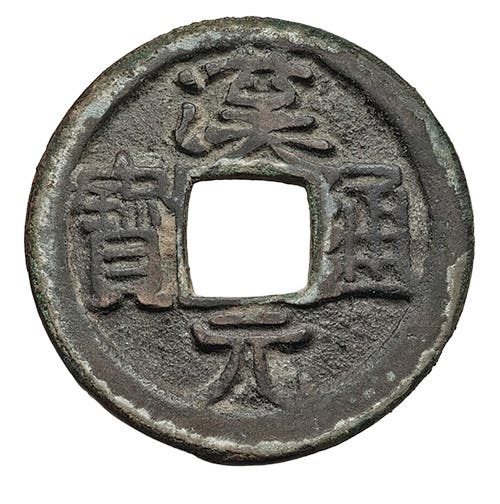
First produced around the 7th to 6th centuries B.C., the bronze “spade” and “knife” money began to circulate. They were quickly followed by the basic form of coinage, recognized as early Chinese coinage, which lasted for over 2,000 years. These coins were cast metal discs with a hole in the center. The holes in the center allowed for the coins to be strung together.
Read Part II of The Evolution of Minting Technology in the April 2026 issue of World Coin News.
Or read Part 2 here: The Evolution of Minting Technology–Part 2