
Monarchs Come Together at Recent Sales
Coins depicting King William III and Queen Mary II, the only joint monarch portraits in British coinage, continue to command interest and strong prices at auction.
Courtesy National Portrait Gallery/Wikimedia Commons.
In late seventeenth-century Britain, not just one, but two portraits of royals were featured on circulating coinage: King William III and Queen Mary. The duo jointly ruled as a double monarchy of England, Scotland, and Ireland after the deposition of England’s last Catholic king, James, during the Glorious Revolution of 1688. Protestant Queen Mary II, who was the niece of King Charles II, and her husband, Dutch royal William III of England, were then given the crown from 1689 until her death from smallpox in 1694. William continued to rule until his death from pneumonia in 1702. Throughout their reign, new issues were minted that visually paired the two monarchs together.
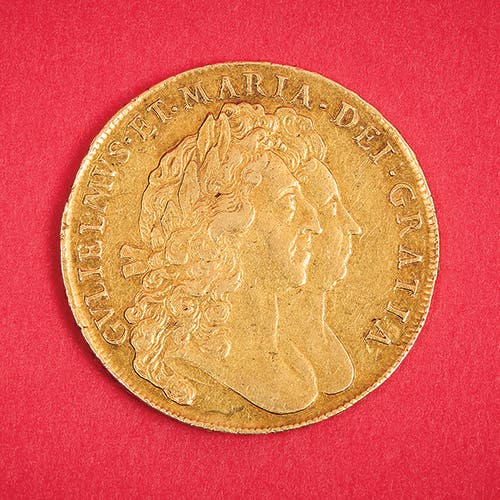
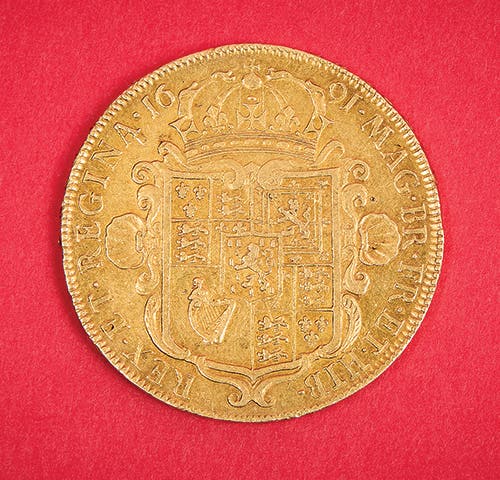
Fast forward over 300 years, and these rare pieces have held prominence at recent auctions and are now prized collectors’ items. They remain as the first and only examples of a dual-monarchy portrait on a British coin.
A recent 1691 example caught collectors’ attention with an ultra-rare gold 5 guinea coin (lot 125) at the March 18 Jewellery Roseberys London sale, which sold for £11,808 to a UK buyer. “This rare coin is a relic of the only time in history when a husband and wife ruled together as equal monarchs. The result reflects its immense rarity and historical importance,” says Catrin Jones GIA GG MJVA, head of jewellery at Roseberys London.
Courtesy of Roseberys.
This 5-guinea issue was of the highest circulating denomination in the late 17th century and was produced in limited numbers. “Only the wealthiest members of society would have handled such a coin,” explains Jones. “The value of the gold will have led many to be melted over the years, increasing the rarity.”
On the obverse of the toothed bordered coin are the profiles of William III and Mary II, and framing the subjects are the Latin legend “GVLIELMVS. ET. MARIA. DEI GRATIA” (William and Mary by the grace of god) and pellet stops. The reverse shows a crowned quartered shield of arms with an escutcheon of the Lion of Nassau that is framed by Latin legends reading, “MAG. BR. FR. ET. HIB REX. ET” (King and Queen of Great Britain, France, and Ireland) and “DECVS ET TVTAMEN ANNO REGNI TERTIO” (An ornament and a safeguard, in the third year of the reign).
Courtesy Stanley Gibbons Baldwin’s.
Courtesy Stanley Gibbons Baldwin’s.
The famous couple also were spotted at the Stanley Gibbons Baldwin’s Ancient, British & World Coins March 30 show in lots 125 and 126. For lot 125, a few extremely fine marks, lightly brushed in the obverse field, 2 guineas from 1693 were sold for £10,455. In lot 126, a 1689 choice extremely fine or better, with a light reddish tone, and a well-struck guinea with an excellent pedigree, was won with a £12,300 bid.
For more information about the March 18 Jewellery Roseberys London sale, visit roseberys.co.uk.
Go to sgbaldwins.com for results from the Stanley Gibbons Baldwin’s Ancient, British & World Coins March 30 show.
You may also like: