Rare William and Mary Five-Guinea Coin from Britain’s First Joint Monarchy Sells at Auction
A rare 1691 five-guinea gold coin depicting joint monarchs William and Mary, struck during England’s Glorious Revolution era, crossed the auction block at Roseberys London.
Auction Update:
The ultra-rare five-guinea gold coin from the joint reign of William III and Mary II sold at Roseberys London on March 18 for £11,808 to a UK buyer. The coin, struck during the brief period when William and Mary ruled as Britain’s only joint monarchs, drew strong interest from collectors due to its rarity and historical significance. “This rare coin is a relic of the only time in history when a husband and wife ruled together as equal monarchs,” said Catrin Jones, Head of Jewellery & Specialist at Roseberys. “The result reflects its immense rarity and historical importance.”
____________________________________________________________________________
A rare surviving coin from 1691 depicting joint monarchs, William and Mary, will go under the hammer at Roseberys London on Wednesday 18 March with an estimate of £9,000-£12,000.
Struck for only six years, surviving examples of coins from the short joint reign of William III and Mary II are exceptionally rare.
Their accession followed the Glorious Revolution of 1688, which saw the deposition of James II and established a Protestant constitutional monarchy in England.
As the highest denomination of the guinea series, five-guinea gold coins were struck in limited numbers and often later melted for their bullion value, making the coins more scarce.
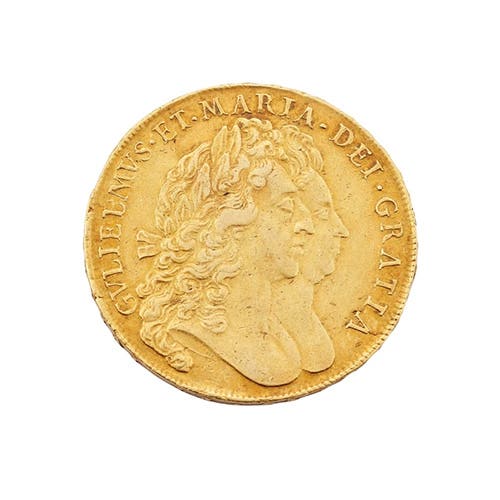
Coinage of the period helped reinforce the legitimacy of the new monarchy, and the conjoined busts of William and Mary, unique within the entire guinea series, reflect the first and only time in English history that a husband and wife ruled as shared monarchs.
The coin carries the Latin inscription GVLIELMVS ET MARIA DEI GRATIA - “William and Mary by the Grace of God” - proclaiming the divine authority of the new monarchs following the Glorious Revolution.
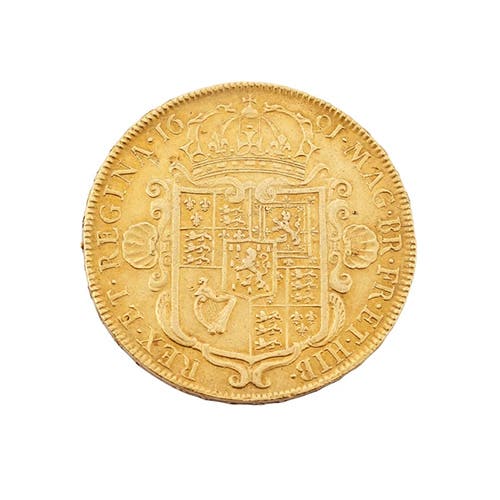
The reverse bears a crowned shield incorporating the Lion of Nassau, referencing William’s dynastic heritage as Prince of Orange, together with the Latin legend MAG. BR. FR. ET. HIB REX. ET., naming William and Mary as rulers of Great Britain, France, and Ireland.
Around the edge runs the inscription Decus et Tutamen, meaning “An ornament and a safeguard”, an element introduced to English coinage in 1662 to prevent the clipping of precious metal.
“The coinage of William and Mary was a powerful symbol of a new political order following the Glorious Revolution. Their conjoined portraits celebrate the only moment in British history when a husband and wife ruled together as equal monarchs,” said Catrin Jones GIA GG MJVA, Head of Jewellery & Specialist. “Five-guinea pieces of this scale were produced in small numbers, and many were later melted for their gold, making surviving examples particularly desirable.”
The coin forms part of Britain’s early gold guinea coinage, produced between 1663 and 1813. Named after the source of the gold used in their production, which originated from the Guinea region of West Africa, the coins continued to circulate only until the great gold recoinage of 1816.
The five-guinea denomination represented one of the highest values in early British coinage, equivalent to 105 shillings, approximately £5.25 in historical value. These substantial gold coins were used primarily for significant transactions among the wealthy.
Among the largest gold coins circulating in 17th-century Britain, five-guinea pieces were often retained as prestige presentation objects rather than spent.
Struck in approximately forty grams of gold and measuring around 37mm in diameter, the present example is graded Very Fine (VF) with light ageing and handling marks.