Item of the Week: 1860-S $3 Gold: A Lightweight in Low Grades
The 1860-S $3 gold coin remains one of the most mysterious issues in the series, shaped by low mintage, melting, and questions about its role in circulation.
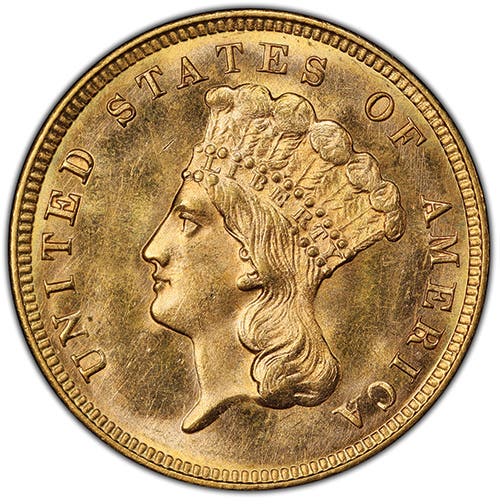
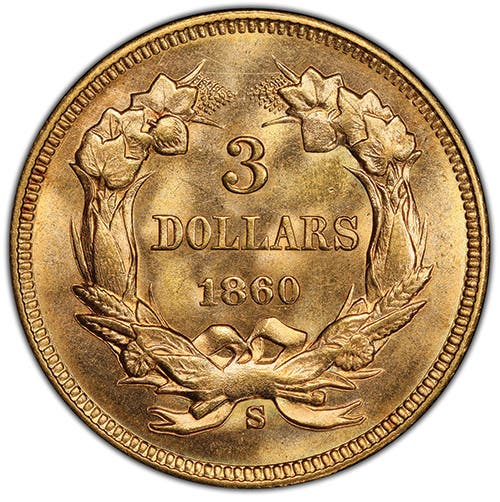
There is a great deal we do not know about the $3 gold coin, and even more we do not understand when it comes to the ones that were issued from 1854 to 1889. But they are interesting, even if the collector numbers are small.
The $3 was a denomination that seemingly had no real purpose. There were $2.50 gold coins that would only leave you a half dollar short of $3 in change, and there were ample supplies of half dollars. There was also an ample supply of gold sitting in California, and that may have been the real reason for a $3 gold. After all, since the discovery of gold, the United States had added a $1 gold and a $20 gold, so a $3 gold coin was not out of line, especially with the advent of 3-cent silver coins.
The $3 gold coin had established itself by 1860 as more of a curiosity than a vital part of commerce. The $3 had made its debut in 1854 and seemingly peaked about the second month of that year. Philadelphia produced more than 138,000 $3 gold coins that year, and no one would do that again. Dahlonega produced 1,120 $3 gold coins in 1854 and never produced another. New Orleans produced 24,000 $3 gold coins in 1854, and it, too, did not produce more.
San Francisco joined in the $3 gold production in 1855, and in gold-conscious California, the $3 might have seen limited use. Unlike New Orleans and Dahlonega, San Francisco would ultimately produce $3 gold coins four times. The first was 1855, followed by 1856, 1857, and 1860.
The mintage of $3 gold coins drifted lower during the 1850s. In 1860, Philadelphia minted 7,155 pieces, which, except for 1858, was a new low for the branch. San Francisco was far removed from the Civil War problems in the East, and it managed a mintage of 7,000 1860-S $3 gold. That was higher than the 1855-S mintage of 6,600, but well below its other two years of production.
There was a good reason that the 1860-S $3 gold has taken on a reputation as a mystery coin over the years. Its mintage was below all but the first year’s mintage from San Francisco, apparently for good reason, as the 1860-S was not necessary.
We know that the mintage was larger than required, for many of the 1860-S $3 gold coins were not released into circulation. A total of 2,592 were reportedly melted in December 1869 for being underweight. In gold-conscious California, underweight coins could present a real problem. Since they were melted, there has never been a chance to test one, but their loss leaves a net mintage of the 1860-S of only 4,408 pieces.
Even with the low total, the 1860-S is reasonable in lower grades. It is priced at $2,950 in F-12. Of course, it must be remembered that, as a $3 gold, the mintages were frequently under 10,000 pieces, meaning there are a host of similar tough dates.
The 1860-S, while available in circulated grades, is an extremely tough coin in uncirculated. It is currently listed at $26,000 in MS-60 – well above average. The Eliasberg 1860-S was graded MS-65, and it brought $20,900, but that was in October of 1982, so any 1860-S in an upper grade is going to be expensive.
The feeling, based on the questions about the weight and destruction of a large part of the mintage, has to be that the 1860-S in any grade is better than we might suspect. After all, gold coins did not always survive in substantial numbers in San Francisco. With the question of weight and the destruction, their chances are further reduced, but with few collectors in $3 gold, we may not really notice a lack of supply.
You may also like: