Connecting Numismatics with America’s 250th Anniversary
With the nation’s 250th anniversary approaching, dealers and collectors can tap into American history to promote numismatics through storytelling, outreach, and local engagement.
The U.S. Mint is issuing a wide range of one-year circulating and collector coinage in 2026 as part of observing the 250th anniversary (semiquincentennial) of America’s Declaration of Independence from Great Britain. This alone is bound to increase the interest in numismatics.
However, if you are a numismatic dealer or collector, how else could you use the occasion of this anniversary to promote the hobby?
This question came up after the company where I work was contacted by a local radio station. They have begun running a series of stories about American history and were looking for sponsors. They are trying to run stories from America’s past that have some relation to the industry of the sponsors. So, what in our nation’s history involves numismatics or money?
Here are twenty concepts we listed, including some relevant to our location in Lansing, Michigan:
- How did a British colony using pounds, shillings, and pence for coinage end up using decimal coinage? Thomas Jefferson was the main proponent of a decimal dollar in the 1780s.
- The U.S. government, under the Articles of Confederation and then under the U.S. Constitution, prohibited the issue of paper until the Civil War because of the terrible inflationary experience with Continental Currency (“Not worth a Continental”).
- When he served as President Lincoln’s Secretary of the Treasury, Salmon P. Chase oversaw the first issues of U.S. government paper money, but later voted that such actions were unconstitutional when he was serving on the U.S. Supreme Court.
- The proposed first coins to be issued by the U.S. government bore the bust of George Washington on the obverse, but Washington refused the idea as it was reminiscent of monarchs putting their portraits on coins.
- The printing company of Hall and Sellers that printed all issues of Continental Currency was the business originally founded by Benjamin Franklin. David Hall went to work for Franklin and, when he bought out Franklin, took on William Sellers as a new partner.
- The Willow Tree, Pine Tree, and most Oak Tree issues were dated 1652 to attempt to skirt around laws against counterfeiting the English king’s coinage. There was no English king on the throne from 1649 to 1660 during the Cromwell Protectorate.
- The issue of private gold coins from the 1830s into the 1860s, including why they began and why they ended.
- The issue of the 1920 and 1921 Pilgrim Tercentenary Half Dollar, depicting Governor William Bradford of the Plymouth Colony, who was a direct ancestor of the founder of our company, Liberty Coin Service.
- R. E. Olds, the founder of Oldsmobile and a local resident, has his signature on U.S. National Currency issued by the local bank that he founded.
- The weight of the U.S. Silver Dollar was determined by taking an average weight of the Spanish 8 Reales (Pieces of Eight) then circulating in the colonies and early independent America.
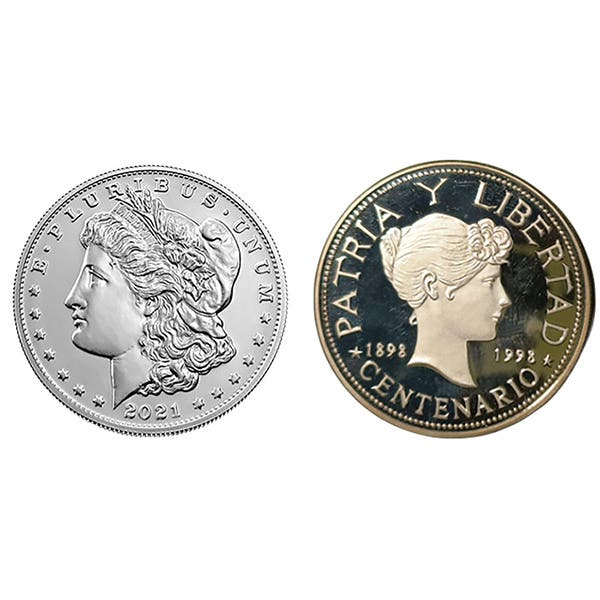
- Identify the required elements on U.S. coinage, including Liberty, United States of America, E Pluribus Unum, and In God We Trust. Why are they used?
- Describe the history of how In God We Trust came to be added to U.S. coins and currency.
- Joseph Jenkins Roberts, the son of a former Virginia slave, was born a free man and became the first president of the newly independent Republic of Liberia, a nation that has issued coins bearing his image (note: I lived in Liberia as a child when my father was in the U.S. foreign aid program)
- Where did the symbol of “$” come from? There is no consensus on this issue.
- The first coin to depict a map of the state of Michigan was the 1936 Cleveland Great Lakes Half Dollar.
- Why were steel cents issued in 1943?
- Identify the living people who have been depicted on U.S. coins.
- The first male and first actual female depicted on U.S. coins (Christopher Columbus and Queen Isabella) never heard of the United States of America.
- Which U.S. president is depicted on both sides of the same U.S. currency? Thomas Jefferson on $2.00 Federal Reserve Notes 1976 to date.
- Why were no Series 1934 $100,000 Gold Certificates released into circulation? Were only issued to be used for gold transactions between Federal Reserve Banks.
There are literally thousands of monetary and numismatic history trivia stories that can be used in a variety of ways to spark an interest in the hobby, especially if you can include points that are relevant to your area. Could you create a trivia contest to submit not just to local coin clubs but to schools, Scouts, churches, senior citizen groups, and the like?
Last column’s numismatic trivia question.
Last time I asked— In addition to gold, silver, platinum, copper, nickel, and zinc, what other materials were used at least once to strike U.S. Mint pattern coins? In addition to these metals, other patterns were struck using aluminum, tin, antimony, tungsten, magnesium, lead, palladium, billon (90 percent copper and 10 percent silver), various alloys of German silver, goloid, oroide, zinc-coated steel, and, in 1942, even plastic.
This week’s trivia question
Here is this week’s question. Which of the eight U.S. presidents born in Virginia were depicted on either U.S. coins or currency before the debut of the Presidential Dollar series? Come back next week for the answer.
Patrick A. Heller was honored as a 2019 FUN Numismatic Ambassador. He is also the recipient of the American Numismatic Association 2018 Glenn Smedley Memorial Service Award, the 2017 Exemplary Service Award, the 2012 Harry Forman National Dealer of the Year Award, and the 2008 Presidential Award. Over the years, he has also been honored by the Numismatic Literary Guild, Professional Numismatists Guild, National Coin & Bullion Association, and the Michigan State Numismatic Society. He is the communications officer of Liberty Coin Service in Lansing, Michigan, and writes “Liberty’s Outlook,” a quarterly newsletter on rare coins and precious metals subjects. He now volunteers with the National Coin & Bullion Association as its Industry Issues Advisor. Past newsletter issues can be viewed at www.libertycoinservice.com. Some of his radio commentaries, "Things You ‘Know’ That Just Aren’t So,” and “Important News You Need To Know,” can be heard at 8:45 a.m. Wednesday and Friday mornings on 1320-AM WILS in Lansing (which streams live and becomes part of the audio archives posted at www.1320wils.com).
You may also like: