Item of the Week: Walking Liberty Half Series Full of Tough Dates
The 1919 Walking Liberty half dollar may lack the fame of the series’ key dates, but its low mintage and modest price make it an appealing coin for collectors.
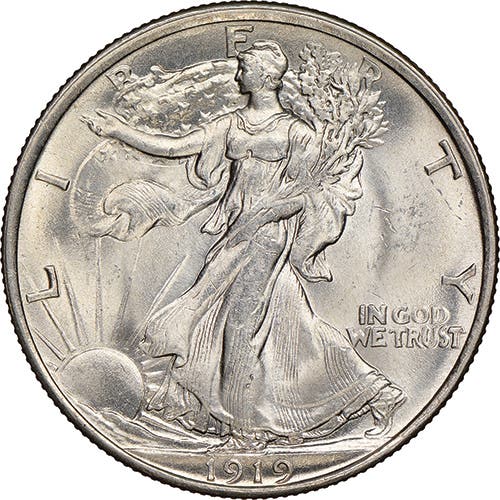
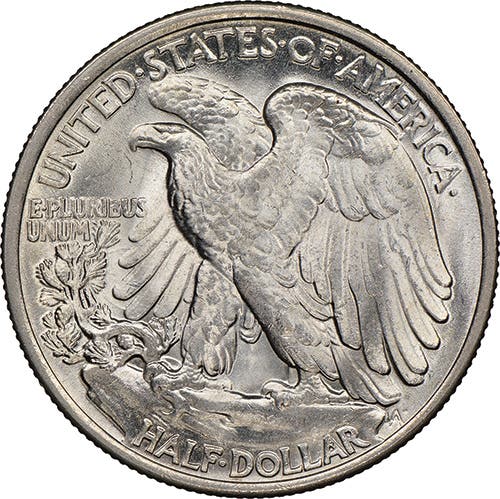
Everyone loves Walking Liberty half dollars. Not only was it a great design, but it also makes a truly great collection. There was virtually anything you could want in a set.
Walkers have relatively common dates that almost anyone could and still can afford in high grades, with MS-65 examples of some of the most available dates priced around $200.
This set also featured a short-lived type with obverse mintmarks in 1916 and part of 1917 before the mintmark was moved to the reverse. The majority of 1917s have a reverse mintmark.
The series also has key dates. Collectors have a kind of love-hate relationship with key dates. We love them if we have them in our sets and sometimes hate them if they are missing. That said, collections in general seem to be more interesting if there is a key date or two.
Walkers really have perfect key dates in that they are tough, but not out of the question in terms of rarity and price. There were three Walking Liberty halves with mintages under one-half million. One does not really count the 1938-D, with a 491,600 mintage. The 1921 at 246,000 and the 1921-D at 208,000 are legitimate key dates, which are joined by the 1916-S, with a 508,000 mintage, and the 1921-S at 548,000. Actually, in circulated grades, the 1921-S is not that tough, but watch out if you want a really nice example because they are among the toughest of all Walking Liberty half dollars.
Where the Walking Liberty half dollar really becomes a great collection is in the number of tough, but not key dates. That is where the 1919 fits. It had a mintage under two million pieces, and it is a lot tougher than prices or its mintage might suggest.
The 1919 had a very low mintage of just 962,000. Any coin of the last century with a mintage under one million pieces has to be taken seriously.
In the case of the 1919, it was easy to overlook as there were so many truly tough Walking Liberty half dollars. By 1919, there had already been four Walking Liberty half dollars with mintages under one million pieces, and in 1921, there were three more, and they all had mintages under 600,000. Moreover, there was nothing especially flashy about a Philadelphia half dollar in 1919. It didn’t have a mintmark anywhere. Its competition was coins like 1916-D Mercury dimes and 1916 Standing Liberty quarters. In 1921, there were new Morgan and then Peace dollars, so these years around World War I were quite active.
It almost seems like collectors have kept viewing the 1919 as the also-ran to those more glamorous dates and denominations. Today, the 1919 Walker costs about $32 in G-4, and you have to think that with that low mintage and years of destruction, there are many worse ways to spend $32.
The 1919 is obtainable in upper grades, though not cheap, with an MS- 60 at $2,000, while you can obtain an AU-50 for $1,000. An MS-65 is $11,000, and that might seem like a lot of money, but actually, there are only a handful of dates from before 1928 that are cheaper, and most were from the first couple of years of the new design, which are years when a new coin is normally saved.
It might not be a great coin, but the 1919 is certainly a much better coin than most, and for its price today, it is a good value as one of the dates that helped to make the Walking Liberty half dollar so special to so many of us.
You may also like: