Surprises In U.S. Mint’s Announced 2026 Circulating Coinage
New 2026 circulating coin designs mark the nation’s 250th anniversary, featuring fresh Liberty imagery, five themed quarters, and echoes of the historic 1976 Bicentennial issues.
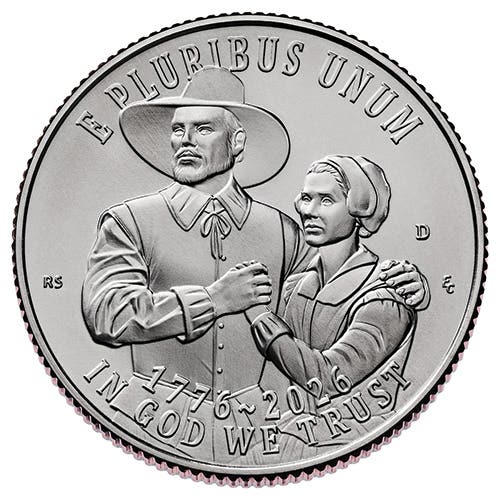
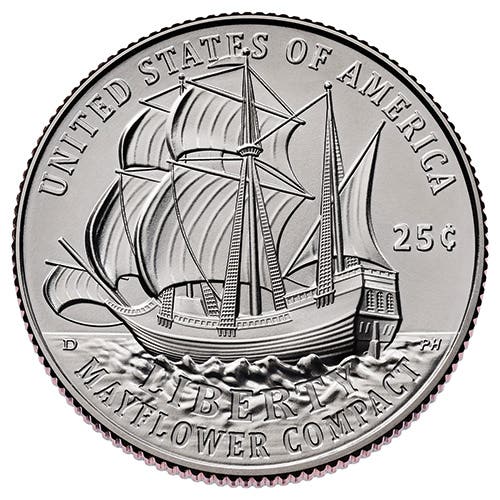
On Thursday last week, the U.S. Mint issued a news release depicting the one-year 2026 circulating coin designs to commemorate the Semiquincentennial of the U.S. Declaration of Independence in 1776.
The enacting legislation for these coins was included in the Circulating Collectible Coin Redesign Act of 2020, signed into law by then-President Trump on Jan. 13, 2021.
One nickel, one dime, and five different quarters will be the coins put into circulation next year. The cent and half dollar will also be produced in circulation strikes, but will only be available if purchased as part of collector sets.
All of these coins will bear the double dates of 1776-2026, similar to the quarters, halves, and dollars dated 1776-1976 for the Bicentennial. The cent and nickel designs will be substantially the same as in 2025, except that they will bear the double dates.
The dime’s obverse features a bust of Liberty never before used for circulating coinage. The reverse shows a unique design of an eagle in flight, clutching arrows in its talons, and the slogan “Liberty Over Tyranny” at the bottom.
There were surprises in the designs for next year’s five quarters. The enabling legislation specified “The Secretary may issue quarter dollars in 2026 with up to five different designs emblematic of the United States semiquincentennial. One of the quarter dollar designs must be emblematic of a woman’s or women’s contribution to the birth of the Nation, or the Declaration of Independence, or any other monumental moments in American History.”
For much of the time since the law was enacted, the U.S. Mint projected that the five quarters would feature the themes of the Declaration of Independence, the U.S. Constitution, abolition of slavery, women’s suffrage, and civil rights. As revealed last week, only two of those themes will appear on the 2026 quarters.
Instead, the five design themes for the quarters will be the Mayflower Compact, the Revolutionary War, the Declaration of Independence, the U.S. Constitution, and the Gettysburg Address. Of these, only the first, the Mayflower Compact, depicts a woman alongside a man. This symbolism is somewhat surprising, as the Mayflower Compact was drafted, adopted, and signed only by adult men aboard the Mayflower who were not in servitude. The other four quarters, respectively, depict George Washington, Thomas Jefferson, James Madison, and Abraham Lincoln on the obverse.
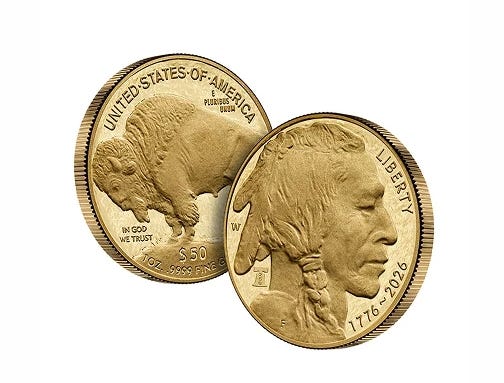
The half dollar’s obverse features a side view of the head of the Statue of Liberty. The closest design to this was the full-face head view of the Statue of Liberty on the U.S. Platinum Eagle obverse. The reverse shows on hand holding a torch reaching out to another hand, with the top reading “Knowledge Is The Only Guardian Of True Liberty.”
The dime, quarter, and half-dollar designs are markedly different from those on current and prior-year coinage. These designs will almost certainly spark a major surge in coin collecting in America, similar to what happened when the Half Cent denomination was ended. The production of Large Cents was replaced by small cents in 1857, the debut of the Kennedy Half Dollar in 1964, just four months after Kennedy’s assassination, and the debut of the Statehood Quarter series in 1999.
Last column’s numismatic trivia question.
Last time I asked—The U.S. government is almost completely ending the practice of sending paper checks. According to Michelle Bowman, who serves on the Federal Reserve Board of Governors, what percentage of U.S. financial transactions this year are paid with paper checks? If measured by the percentage of financial transactions, only about 5-7 percent are settled by check. However, this relatively small percentage of checks used in transactions accounts for 21 percent of the dollar value of all funds transferred.
This week’s trivia question
Here is this week’s question. When the Roosevelt Dime debuted in 1946, a year after President Franklin Roosevelt’s death, some people speculated that the initials “JS” in the field just below Roosevelt’s neck were a tribute to Soviet leader Joseph Stalin, a world leader with whom Roosevelt had cooperated in fighting World War II. What is the actual meaning of those initials? Come back next week for the answer.
Patrick A. Heller was honored as a 2019 FUN Numismatic Ambassador. He is also the recipient of the American Numismatic Association 2018 Glenn Smedley Memorial Service Award, 2017 Exemplary Service Award, 2012 Harry Forman National Dealer of the Year Award, and 2008 Presidential Award. Over the years, he has also been honored by the Numismatic Literary Guild, Professional Numismatists Guild, National Coin & Bullion Association, and the Michigan State Numismatic Society. He is the communications officer of Liberty Coin Service in Lansing, Michigan, and writes Liberty’s Outlook, a monthly newsletter on rare coins and precious metals subjects. Past newsletter issues are available at www.libertycoinservice.com. He now volunteers with the National Coin & Bullion Association as its Industry Issues Advisor. His radio commentaries titled “Things You ‘Know’ That Just Aren’t So, And Important News You Need To Know” can be heard at 8:45 AM on Wednesday and Friday mornings on 1320-AM WILS in Lansing (which streams live and becomes part of the audio archives posted at http://www.1320wils.com).
You may also like: