
Hotz off the Press: Striking Gold with Goldthwaite, Texas Notes
A visit to Goldthwaite, Texas, traces the rise and fall of two small national banks and the remarkably rare Texas notes they issued.
Welcome to the new year of 2026. With that, I begin what I believe is my 31st year of writing for Bank Note Reporter! I am continuing to visit areas around the country and introduce you, my readers, to many obscure small towns and their national banks, most of which you would have never learned of. At the same time, I can showcase notes from my own collection, the acquisition of which leads me to the history of their issuing towns. To that end, this month we will visit the small town of Goldthwaite, Texas.
Goldthwaite, the county seat of Mills County, is at the convergence of U.S. highways 84 and 183, State Highway 16, and Farm roads 574 and 572, in the central part of the county. Goldthwaite lies about 150 miles southwest of Dallas and 100 miles northwest of Austin.
The town was established in what was then southern Brown County in 1885, with the coming of the Gulf, Colorado, and Santa Fe Railway, and the post office opened a year later in 1886. It was named for Joe G. Goldthwaite, the railroad official who conducted the auction of town lots.
After Mills County was organized the following year, several landowners donated townsite property in exchange for assurances that Goldthwaite would be selected as the county seat. A county courthouse was completed in 1890; the first county jail, constructed in 1888, is now on the National Register of Historic Places.
The Santa Fe built shops and a roundhouse switch, intending Goldthwaite as a division point. But after labor problems in the town, the railroad moved its shops to Brownwood.
Even without the railroad, the town flourished. By 1898, it had a population of 1,200, three churches, a bank, a number of hotels and boardinghouses, two cotton gins, two gristmills, a public and a private school, many stores, and two weekly newspapers, The Eagle and The Mountaineer.
The courthouse burned in 1912 and was replaced the following year with a brick structure. The county’s first school library was established in 1915, the same year construction began on the manmade reservoir Lake Merritt, seven miles from town. By 1928, Goldthwaite had 2,800 residents and 95 businesses.
The population fell to 1,324 by 1931 due to drought and economic hardship, and the number of businesses declined to 55 by 1933. After the Great Depression, recovery in Goldthwaite was modest, but agricultural diversification brought prosperity.
In 1988, the town’s economy was based on wool, mohair, cattle, sheep, pecans, grains, and the production of farm equipment. In 1990, the population was 1,658, and in 2000, it was 1,802.
Mills County experienced significant growth from 1887 to 1917, following the establishment of the Gulf, Colorado and Santa Fe Railway in the region. As Goldthwaite became the county seat and center, locals saw the need for a bank.
On June 4, 1888, Daniel H. Trent opened a private bank at the east corner of Fisher and 4th streets, with deposits of $4,168.61 and a stock account of $11,449.50. Four years later, Trent joined other local businessmen to organize the First National Bank of Goldthwaite, charter #4687, with Trent as president and W.E. Miller as cashier.
The First National Bank of Goldthwaite turned out to be a very small and ultimately unsuccessful affair. It issued 714 sheets of “Series of 1882” brown back notes for a total issue of $35,700, of which just a single example is known today. After only four years in business, in 1901, the bank’s stockholders voted to liquidate, and the building, along with the furniture, was sold back to Trent, who reopened his bank. In 1908, Trent’s private bank reorganized as the Trent State Bank and still operates today as the Mills County State Bank.
It is not exactly clear why the stockholders of the First National Bank chose to liquidate it—perhaps there was friction between Trent and cashier Miller and other bank officials—but W. E. Miller went on to organize the Goldthwaite National Bank immediately after the liquidation of the First National Bank, and he became its first president.
The Goldthwaite National Bank was organized in late 1901 and received charter #6092. Unable to use the old First National Bank building, as it was now re-housed by the D.H. Trent Bank, the Goldthwaite National Bank opened in a central storefront on the same block. J.D. Harris served as the first cashier.
The Goldthwaite National Bank operated for 22 years until it was ultimately liquidated in 1924. It issued a smattering of “Series of 1882” brown back, date bank, and value back notes, and a few “Series of 1902” plain backs. The total issue was just over $200,000.
Currently, 15 notes are known from the Goldthwaite National Bank—the only brown back examples are four Serial #1 notes from the first sheet, which were saved by the bankers and cut up. The individual notes have illustrious pedigrees—one of the $10 notes was in the Philpott Collection, another was obtained by J.L. Irish for his impressive collection, and the $20 hails from Albert Grinnell.
Serial #1 Texas brown backs are rare; just 30 are known from the state. Of these, seven are sequestered in institutional collections, leaving just 23 available to collectors, and the Goldthwaite notes represent 17% of them.
I recently obtained one of these notes from a Heritage Auctions sale. As the notes were long separated, they have not fared equally.
The $20 brown back from Grinnell has been badly trimmed around and damaged; the Philpott $10 note is in a PMG VF30 Net holder marked “residue and repaired”; another $10 has not been seen for years, and the final $10 brown back.
The J.L. Irish note, graded Extremely Fine 45 PPQ, was obtained by me. It truly is a lovely trophy note and has excellent pen signatures of J.D. Harris, cashier, and W.E. Miller, president.
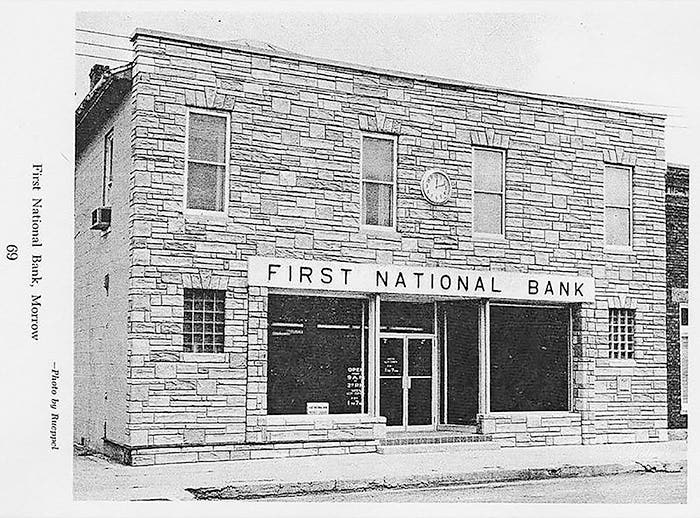
I was fortunate to find several vintage photographs of the Goldthwaite business district, showing the D.H. Trent Bank (later First National Bank) and the Goldthwaite National Bank. The Trent building is the most impressive as a typical multi-story corner block, but the Goldthwaite National Bank was incongruously housed in a storefront wedged between two different grocery stores!
Goldthwaite today is dominated by the Mills County Courthouse, erected in 1913 after the original courthouse was destroyed by fire. The historic Mills County Jail, constructed in 1888, sits on the courthouse lawn, facing Fisher Street. It was built before the courthouse and features a layout in which the sheriff lived on the bottom floor, and the inmates were housed upstairs. It is listed on the National Register of Historic Places.
Readers may address questions or comments about this article or national bank notes in general to Mark Hotz at markbhotz@gmail.com.
You may also like: