
CoinClinic: The Use of Bank Notes Instead of Coins
From ancient coin receipts to China’s “flying money,” the evolution of bank notes tells a fascinating story of innovation, trust, and convenience in how we trade and save.
When did bank notes become cash alongside coins?
Since large numbers of coins can be cumbersome to handle, transport, and store, there have been receipts issued for coins since ancient times. Sometimes these receipts were issued by banks, but many of these early receipts were issued by some private entity that stored the coins pledged against the receipt. The bank note, as we know it today, can likely be attributed to China. Paper notes called “flying money” were issued by merchants during the 7th century in the Tang dynasty. It was during the 11th-century Song dynasty that the government first issued centralized paper money.
Is it true that Marco Polo introduced bank notes to Europe from China?
Marco Polo wrote about what he learned in 13th-century China in the chapter titled “How the Great Khan Caused the Bark of Trees Made into Something Like Paper to Pass for Money all over his Country” in his book The Travels of Marco Polo. Bank notes, however, were already in use in Europe before this time. According to 10th-century Jewish merchant traveler Ibrahim ibn Yaqub, pieces of cloth set at an exchange rate against silver were in use in Prague in 960. Notes acknowledging the value of deposits that could be used as a substitute for those deposits were issued to pilgrims by the Knights Templar around 1150.
When did paper money first come to America?
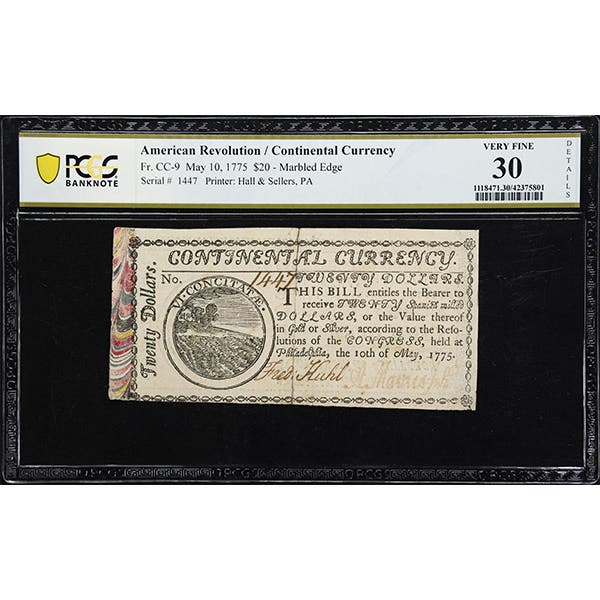
The first paper money to be issued in what would become the United States was issued by the Massachusetts Bay Colony in 1690 to help fund a military action against English Canada during King William’s War. Massachusetts was no stranger to such controversies, having struck its own coins in 1652. The 1690 Massachusetts notes were promissory notes, but were called bills of credit.
Bank notes are printed on paper or polymer today. Are there other materials on which bank notes have been printed?
Bank notes have been printed on different materials depending on the expense involved, need for durability, security, or the environment to which the notes will be subjected. A blend of cotton and linen fibers is commonly used, although this is increasingly being replaced by more durable synthetic polymer products. Leather, wood pulp, and other plant fibers, as well as silk, have been used in the past, some of these being used as an emergency substitute for paper.
When and where was the first polymer bank note issued?
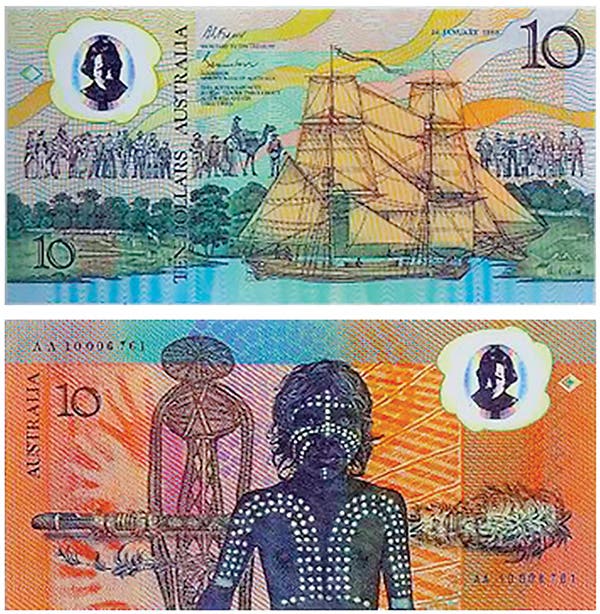
The first polymer composition bank notes were issued in 1988 by the Reserve Bank of Australia, this being a commemorative issue marking Australia’s bicentennial year. The notes were developed with the cooperation of the Commonwealth Scientific and Industrial Research Organization. Canadian engineering company AGRA Vadeko and Mobil Chemical Company developed a polymer that was tested by the Bank of Canada during the 1980s and 1990s; however, Canada didn’t introduce its first polymer composition banknote until 2011.
Has the United States considered switching from paper to polymer bank notes?
According to the U.S. Treasury, our current paper-based bank notes last between 4.7 and 22.9 years. This, of course, includes all denominations. The dollar bill, as the workhorse denomination, has a significantly lower life expectancy. It is known that the Bureau of Engraving and Printing tested the DuraNote trademarked polymer developed by AGRA Vadeko and Mobil Chemical Company in 1997 and 1998, but nothing has been said of any possibility of using the polymer in the future has been made public more recently.
You may also like: