CoinClinic: Encased Postage Currency
Born from Civil War coin shortages, encased postage combined stamps and advertising to fill the gap in small change and became a unique collectible in its own right.
Is there any advantage to investing in either bullion bars or bullion coins?
There is no legal monetary denomination for bullion bars or ingots. Bullion-oriented coins have an assigned minimum or face value. Bullion products are typically manufactured privately. For that reason, they may be more cost-effective than bullion coins; however, government-produced products tend to command a higher premium. What needs to be considered when investing in either ingots or coins representing bullion values is buyback values, investment horizons, your goals, and taxes.
Is it possible for the face value of a bullion coin to exceed that coin’s intrinsic value?
The face value of a bullion coin is purposely assigned with this potential problem in mind. Theoretically, it is possible for the face value of a nation’s bullion coinage to exceed its intrinsic value, but for practical purposes, this won’t happen. Taking the U.S. Gold American Eagle as an example, a one-ounce coin has a face value of $50, while the ounce of gold in the coin is currently worth in excess of $3,000. It would take a catastrophic drop in the spot price of precious metal gold for this to happen.
Where did the idea for encased postage currency originate?
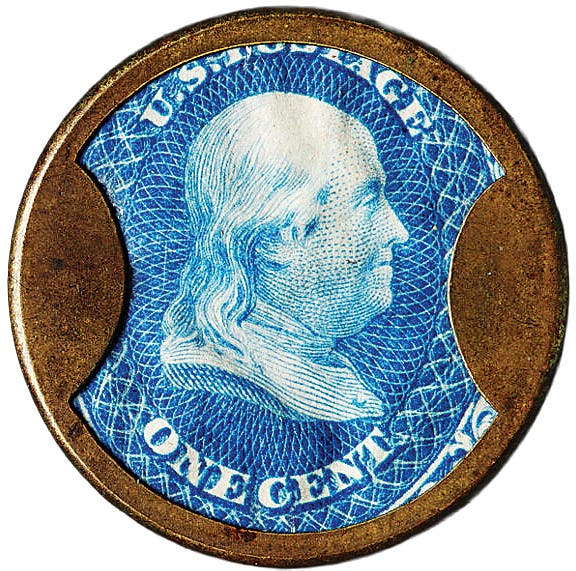
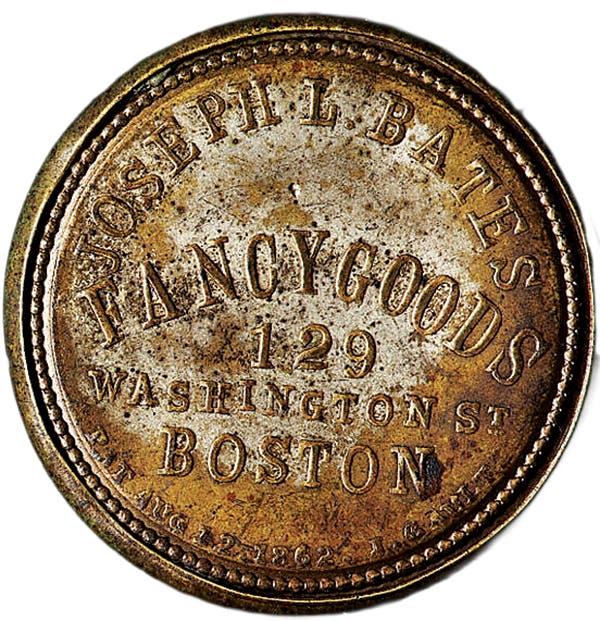
Inventor and entrepreneur John Gault can be credited with introducing encased postage currency. On July 17, 1862, the government reacted to the shortage of specie coinage during the Civil War by allowing postage stamps to be used as a substitute currency. Since stamps are easily damaged when being handled, Gault developed a coinlike brass holder (initially a silver holder) with a window of mica sheeting that protected the stamp while encouraging it to be treated as if it were a coin.
It would cost Gault money to produce his postage currency holders. Was he able to profit from this venture?
Gault took advantage of the holders in which the stamps were housed, selling advertising space in raised lettering on the metal jackets holding the stamps. Among Gault’s advertisers were Aerated Bread Company, Ayer’s Sarsaparilla and Cathartic Pills, Joseph L. Bates Fancy Goods, Buhl & Co. Hats and Furs, Burnell’s Cocoaine, Drake’s Plantation Bitters, Ellis McAlpin & Co. Dry Goods, Lord & Taylor, Sands Ale, Tremont House, and White the Hatter. The advertisers ranged from New York to Cincinnati.
How successful was Gault’s encased postage currency?
Gault’s only real competition was the U.S. government. The government had allowed postage stamps to be used in amounts up to $5 face value. A few 2-cent encased stamps were produced in 1863 by the post office, but the end really came following the August 1862 introduction of government-issued postage currency bank notes issued in small denominations. The initial issue of fractional notes depicts images of stamps.
Has the idea of Gault’s encased postage currency been used elsewhere?
Encased postage currency was introduced following World War I in Austria, Denmark, France, Germany, and Italy. These emergency issues were manufactured by private companies and just had Gault; their manufacture was paid for through advertisers. Encased as well as postage mounted on what appears to be reminiscent of cardboard bottle caps was used during small change shortages in Spain during the Spanish Civil War period of 1936.
E-mail inquiries only. Do not send letters in the mail. Send to Giedroyc@Bright.net. Because of space limitations, we are unable to publish all questions.
You may also like: