19th Century Glassworks U.S. Obsolete Notes, Part 1
A forgotten industrial giant, 19th-century glassmaking lives on through the merchant notes and scrip it left behind.
When we think about the most prevalent industries in 19th-century America, many examples come to mind: railroads, coal, iron (steelmaking), and oil. One industry often overlooked but that played an important role during the Industrial Revolution was factory glassmaking.
The mechanical pressing of glass and the continuous sheet production complemented traditional hand-blown methods, such as crown glass and cylinder glass. Mechanized 19th-century glassmaking produced a wide array of products, including tableware such as dishes and glasses; functional containers such as bottles, flasks, jars, and inkwells; decorative items such as art glass, cut glass, and engraved pieces; and building materials such as window glass and plate glass.
Mold pressing of glass allowed for mass production and the creation of large factories. In the 19th century, over 500 glass factories were scattered across the United States.
In this two-part article, we will explore merchant notes and scrip from various United States-based glass manufacturers. Next month, we will conclude Part 2 of this coverage on obsolete notes from 19th-century glassworks. Thanks to Heritage Auctions for the photographs contained.
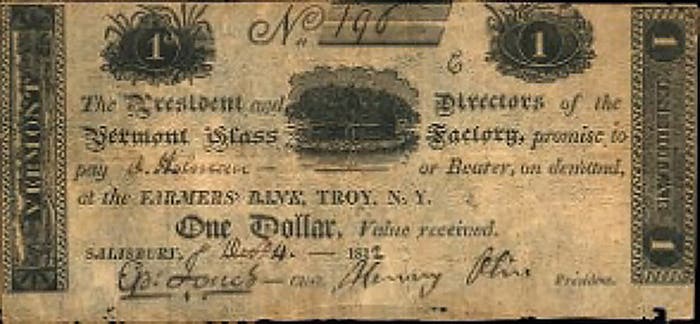
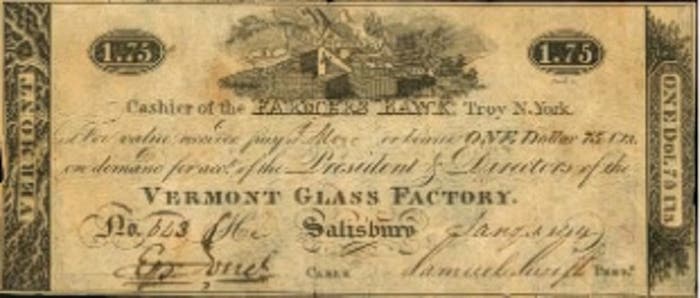
Above: 1812 and 1815 signed $1 and $1.75 notes from the Vermont Glass Factory. Henry R. Schoolcraft founded the factory in Salisbury in 1812 and later added a second factory in Middlebury. The factory specialized in window glass.
Above: January 1815 3¢ and 5¢ notes from the Hamilton Glass Factory in Albany, New York. Named after the first United States Treasurer, Alexander Hamilton, the factory opened in 1786. Below: A surviving bottle from the factory.
Above: Between 1810 and 1822, the Oneida Glass Factory produced window glass. It was located near abundant sources of wood for fuel and sand (a primary ingredient in glass) and was one of a half dozen area glass factories. Shown are 25¢, 50¢, and 75¢ remainder notes dated June 15, 1815, with a Roman god vignette from Oneida, New York. Bottom right is an artist rendering of how plate glass was produced in the 19th century.
Above: 10¢ & 25¢ January 1, 1863, Crowleyville Glass Co. remainder notes. The company was formed in 1863 by Isaac Weeks and Samuel Crowley. By 1864, the company had changed its name to Burlington, Atlantic, Cape May, and Philadelphia Glass Co., with the plant known as the Atlantic Glass Works. The notes were intended for use by employees in the company store.
Above: $2 Millville, New Jersey—Shetter Glass Works, near Millville, New Jersey, dated July 11, 1837. In 1832, Frederick Shetter built a glassworks factory just south of Millville, and in 1854, it was incorporated into Whitall and Tatum. This was purchased by the American Can Company and is now the oldest continuously operating glassmaking company in the United States.
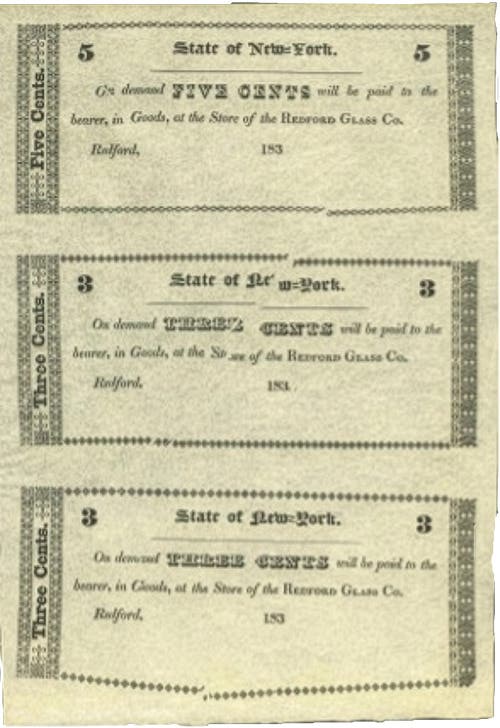
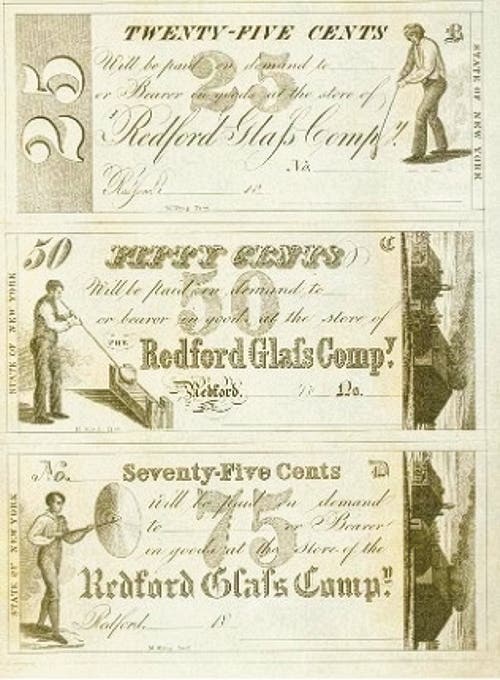
Above left: Uncut sheet 3¢, 3¢, and 5¢ remainder notes from Redford Glass Co. of New York. It is dated 183x. Factory production began in 1831 and closed 20 years later in 1851. Right: Second uncut Redford remainder sheet (25¢, 50¢, and 75¢), likely a later issue, with images of glass workers. Redford’s main product was window glass—the factory produced about 10,000 boxes of it annually. Redford also made decorative glass. Below: A lovely example of a Redford glass pitcher with a raised lily-pad design feature. The aqua color of their glass was prized.
Above: An uncut merchant note sheet from Eagle Glass Works Store from Port Elizabeth, New Jersey, 3¢, 5¢, 5¢,10¢, 20¢, 50¢, 50¢, and $1 dated May 1, 1859. Port Elizabeth, New Jersey—The Eagle Glass Works, built in 1799 in Port Elizabeth, only the 3rd glass factory in New Jersey. Founded by James and Thomas Lee, with a group of Philadelphians building a factory at Manumuskin Creek, a branch of the Maurice River in southwest New Jersey.
Above left: 1870 $1 remainder from the Berkshire Crystal Glass Works, Berkshire, Massachusetts. An allegorical image of America is triumphantly carrying the United States flag. The Berkshire Glass Works was a prominent 19th-century window and stained-glass manufacturer that operated from 1853 to around 1900. It was highly regarded for its high-quality colored glass, which is featured in landmarks like Memorial Hall at Harvard and Boston's Trinity Church. Right: 1¢ note dated January 1, 1855, Milford Glassworks merchant note. An allegorical woman is sitting, scroll in hand, in front of the factory. The factory operated from 1846 to 1863. Among the items manufactured were bottles for druggists, goblets, and green beer bottles.
Above: 10¢ and 5¢ remainder pair dated November 1, 1862. From Chas P. Poinier of Boston, Massachusetts. A patriotic eagle graces the notes. Mr. Poinier also owned a rubber factory. Note their specialty stated on top: “LOOKING GLASS & PICTURE FRAME MANUFACTURER.”
Above left: January 1st, 1863, remainder note from Rosenbaum & Hay from the glass manufacturing area of New Jersey. Right: October 1871 numbered note from Cohansey Glass Mfg. They manufactured fruit jars and plate glass. Below: An example of their glass jar with “COHANSEY” in raised letters.
Above left: January 1st, 1863, remainder note from Rosenbaum & Hay from the glass manufacturing area of New Jersey. Middle: October 1871 numbered note from Cohansey Glass Mfg. They manufactured fruit jars and plate glass. Right: An example of their glass jar with “COHANSEY” in raised letters.
All images courtesy: Heritage Auctions.
You may also like: