Will The U.S. Mint Saturate the Numismatic Market?
From privy marks to special finishes, the expanding Silver Eagle lineup raises a critical question: is variety fueling collector excitement or oversaturating the market?
For decades, the U.S. Mint sold proof and mint sets and commemorative coins at prices right at or not all that much higher than the face value of the respective coins. For example, the Mint sold 1960 proof sets to the public for 91 cents, right at the face value of the coins in that set. Many of the classic commemorative half dollars could be purchased for $1 or less.
A number of mints around the world are “minting” profits by striking a huge variety of coins for collectors instead of for circulation. For example, the Royal Canadian Mint strikes over 300 different coins each year, with only a handful of issues for circulation purposes.
The governments of a number of less affluent nations have been able to raise revenues by collecting royalties from authorizing issues of non-circulating legal tender (NCLT) coins that were then marketed primarily to American collectors. Examples of such countries were (and in some instances still are) the Cook Islands, the Isle of Man, Liberia, the Marshall Islands, Niue, and several Caribbean nations.
In most instances, marketers promoted a coin issue, then found a cooperative government and mint to authorize and strike the pieces. In 2003, in anticipation of the forthcoming January 2004 Michigan statehood quarter release, I was contacted with offers from seven different nations that were willing to accept royalties to issue one-ounce silver coins also commemorating Michigan statehood. While the concept did have some interest, the cost of the royalties to all the different parties (treasury of the authorizing nation, the mint that would strike the pieces, the agent for these parties, and more) exceeded the value of the silver at the time. In my judgment, the retail price of such coins would have to be so high compared to the silver value that they would not represent good value to our potential customers. Therefore, I didn’t pursue any of the options.
The U.S. Mint is limited as to the variety of coins it can issue by the laws passed by Congress and signed by the president. It cannot initiate any new programs on its own. Faced with that restriction, the U.S. Mint in recent decades has taken to producing authorized coins with special finishes. Perhaps the most extreme example has been the U.S. Silver Eagle Dollars, which contain one ounce of .999 fine silver.
When Silver Eagles were first issued in 1986, the only two options were uncirculated coins struck in Philadelphia and a proof version struck at the San Francisco Mint. Proof coin production was switched to the Philadelphia Mint in 1993. In 2000, production of the uncirculated coins was officially acknowledged as coming from the West Point Mint. In 2001, the Proof Silver Eagles were switched to also be struck at West Point.
In 2006, the product line was expanded with a Burnished Silver Eagle Dollar struck at West Point, and a Reverse Proof Silver Eagle struck in Philadelphia. The Reverse Proof Silver Eagles were intermittently struck in subsequent years, some at Philadelphia and some at San Francisco. An Enhanced Uncirculated Silver Eagle was struck at West Point in 2013. Regular Proof issues were sometimes struck at both San Francisco and at West Point.
In 2020, for the 75th anniversary of the end of World War II, a Proof Silver Eagle Dollar with a privy mark was struck at West Point. In 2024, 500,000 uncirculated Silver Eagle Dollars with a star privy mark were produced at West Point.
In 2025, the Silver Eagle product line expanded with an uncirculated version featuring an eagle privy mark struck at Philadelphia, a laser-engraved proof version with a laser beam privy mark minted in West Point, a proof issue from San Francisco with a United States Navy privy mark, a proof issue out of West Point with a United States Army privy mark, and a proof coin from Philadelphia with a United States Marine Corps privy mark.
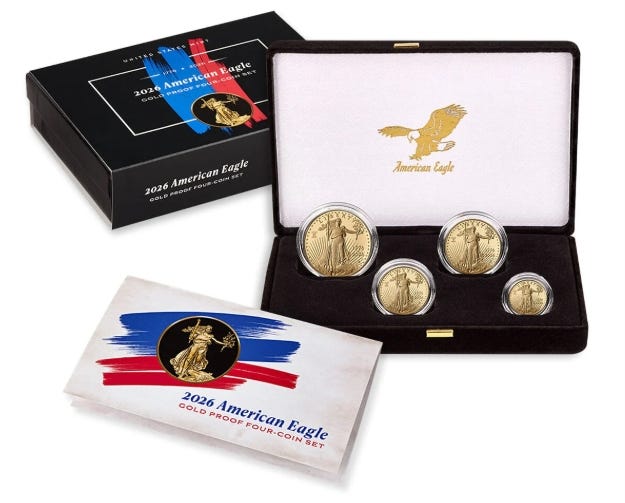
It is possible that the U.S. Mint is considering adding serial numbers to some Silver Eagle Dollars, creating another version of a Congressionally authorized coin. What could come next? Colorized coins? Will there be any special privy marks in 2026 for the 250th anniversary of independence?
Collectors have limited budgets, some modest and some enormous. While there are a number of collectors of the annual uncirculated bullion issue, even that is becoming a challenge with today’s record high levels of silver prices. Even fewer collectors have the budget to try to accumulate all the different varieties of uncirculated and proof Silver Eagles.
While it is understandable that U.S. Mint officials have an interest in maximizing revenues and profits while working within Congressional constraints, is it possible that the market is becoming so saturated with varieties of Silver Eagles and special editions of other coinage that it will diminish future collector interest?
Last column’s numismatic trivia question.
Last time I asked— Which state, when it was an independent nation, had scrip issued by its own naval department? The Republic of Texas was an independent nation from 1836 until it joined the United States in 1845. It had its own Navy. In 1841, the government did not allocate funds to the Navy so that it could pay its personnel and expenses. In anticipation of receiving eventual funds, the Texas Navy issued scrip (pay warrants) in the amounts of $25 and $50 to the sailors. Effectively, these were IOUs or promissory notes. Funding later came through, and the scrip was redeemed. Today, this scrip is a treasured collectible for numismatists focusing on Texas history.
This week’s trivia question
Here is this week’s question. Which living people were depicted on U.S. Fractional Currency that was placed into circulation? Come back next week for the answer.
Patrick A. Heller was honored as a 2019 FUN Numismatic Ambassador. He is also the recipient of the American Numismatic Association 2018 Glenn Smedley Memorial Service Award, the 2017 Exemplary Service Award, the 2012 Harry Forman National Dealer of the Year Award, and the 2008 Presidential Award. Over the years, he has also been honored by the Numismatic Literary Guild, Professional Numismatists Guild, National Coin & Bullion Association, and the Michigan State Numismatic Society. He is the communications officer of Liberty Coin Service in Lansing, Michigan, and writes “Liberty’s Outlook,” a monthly newsletter on rare coins and precious metals subjects. He now volunteers with the National Coin & Bullion Association as its Industry Issues Advisor. Past newsletter issues can be viewed at www.libertycoinservice.com. Some of his radio commentaries, "Things You ‘Know’ That Just Aren’t So,” and “Important News You Need To Know,” can be heard at 8:45 a.m. Wednesday and Friday mornings on 1320-AM WILS in Lansing (which streams live and becomes part of the audio archives posted at www.1320wils.com).
You may also like: