Seated “CC” Dollars That Make You Stand Up and Take Notice
Carson City Seated dollars are among the rarest in U.S. coinage, with low mintages and even lower survival rates making them standouts for collectors.
Some of the greatest rarities in American numismatics were struck at the historic Carson City Mint in Nevada. In this article, you will be introduced to four Seated Liberty dollars and six Trade dollars, all of which circulated—in both the United States and China. It is common knowledge that the Trade dollar circulated in China, for it was produced for that purpose.
Earlier on, Seated Liberty dollars were sent to China in trade. Why? Because they always had an intrinsic value of more than a dollar, which made them de facto bullion. The existence of several Seated Liberty dollars with Chinese chop marks is compelling evidence of their use in the China trade.
An interesting idea would be to acquire one of the coins discussed in this article to include in your collection.
1870-CC Seated Liberty Dollar
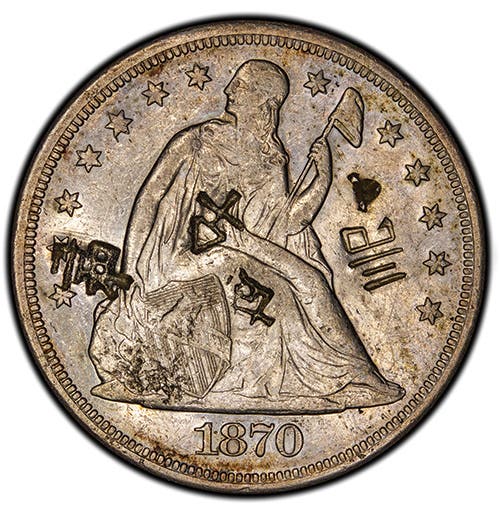
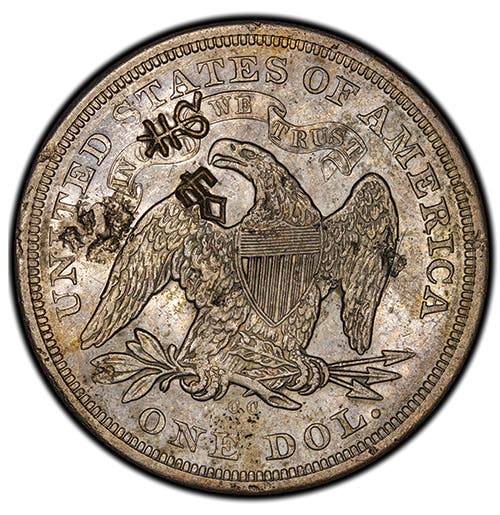
Above: A rare 1870-CC Seated Liberty dollar with chop marks, offering evidence of Carson City Seated dollars being employed in the China trade. (Photo courtesy of Dan Huntsinger from his private collection.)
The 1870 Carson City silver dollar is an intriguing issue. It was the very first coin struck at the famed Nevada mint. It’s also the only Seated Liberty Dollar from Carson City available to collectors. Countless numismatists want to own this historic coin. David Bowers writes, “The 1870-CC, the first Carson City dollar issue, was minted to the extent of just 11,758, the total of monthly production figures per Mint records.”
Despite its small mintage, examples exist in decent numbers in circulated grades, demonstrating that it was used in everyday commerce—and saved. Bowers continues, “John Kroon reported that he saw 17 specimens at a single coin show …. Dale Phelan wrote that in 1992 a hoard of 82 coins in lower grades was in a private collection.… Hundreds of specimens exist, many of which show extensive wear.” Additionally, writes Bowers, “Examples of Mint State 1870-CC dollars, while quite rare, are more available than any of their other Carson City brethren in the Liberty Seated series.”
The 1870-CC circulated in the West. However, Seated Liberty dollars were also employed in the China trade. People in the West employed hard money in day-to-day commerce, but the dollar coin was never a common circulating medium. That is why mintages of Seated Liberty dollars were always small. There is one known chop-marked 1870-CC dollar, which demonstrates that this issue was sent to China. In 1870, a silver dollar had an intrinsic value of $1.027, making it de facto bullion. When that happened, merchants would send Seated Liberty dollars to China in trade. But there was a small amount that circulated, especially in the West.
Graded coins:
PCGS (original): 630 (details)? (PCGS’s details grade census is not available to collectors)
NGC (original): 270 (details) 894
Above: A Canton harbor in 1850. Many U.S. Seated Liberty dollars and Trade dollars entered China via Canton. (Photo courtesy of Wikimedia Commons.)
1871-CC Seated Liberty Dollar
“The 1871-CC is quite famous and has been admired for decades. Examples are highly prized in any grade,” writes Bowers.
It is rare in all grades. NGC estimates there are 100 survivors overall. Bowers writes, “Of the 1,376 1871-CC dollars struck, probably 85 to 125 exist today in circulated grades. This remnant, amounting to 6 percent to 9 percent of the original issue, indicates that the rarity of the 1871-CC was recognized at an early date.” Noticeably, the relatively large (in comparison) mintage of 1870 significantly reduced the need for dollars in 1871. Judging by the small mintages of the following two years, there was never a considerable need for these coins, but they did indeed circulate. However, it is possible that most of them ended up in China, due to their intrinsic value being over a dollar.
Graded coins:
PCGS (original) 134 (details)?
NGC (original) 47 (details) 52
1872-CC Seated Liberty Dollar
With a mintage of only 3,150 pieces, this is a rare issue. Bowers writes, “Today, the number surviving is in the range of perhaps 150 to 200, including lower grades in the Good, VG, and Fine ranges. Opinions on the number of survivors vary …” Bowers continues, “I believe that most 1872-CC dollars circulated after 1873 when their intrinsic value dropped below their face value.” However, that appears to be a questionable theory about the hard money West and when considering the usage of silver dollars in the China trade. R. W. Julian writes, “…dollars were struck only for private depositors.” That suggests that they were struck for use in the local Carson City/Western economy, as well as, due to their intrinsic value of over a dollar, for export to China.
Graded coins:
PCGS (original) 267 (details)?
NGC (original) 98 (details) 140
Above: The clipper barque Spirit of the Age, 1854. Illustration by T.G. Dutton. Ships such as this were active in the U.S.-China trade and carried Seated dollars and Trade dollars in their bullion rooms. (Photo courtesy of Wikimedia Commons.)
1873-CC Seated Liberty Dollar
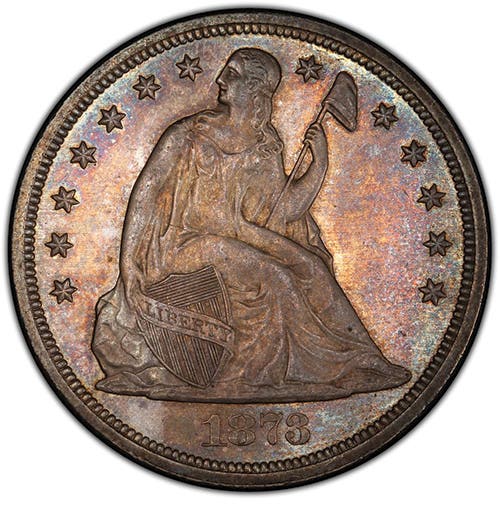
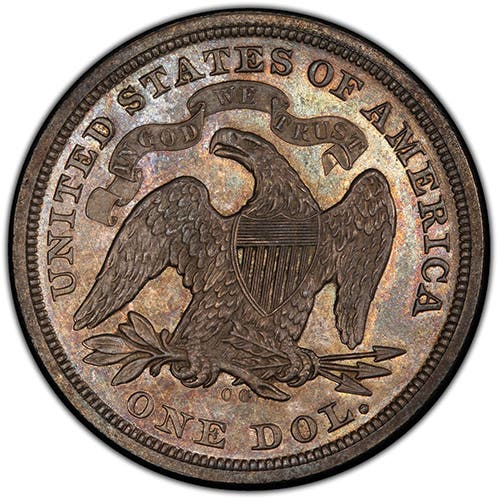
Above: An 1873-CC Seated dollar graded MS65 by PCGS, the finest known of this issue. Writes Bowers, “This is the most famous of all Carson City Mint Liberty Seated dollars and also the rarest.” (Photo courtesy of PCGS Coinfacts.)
“This is the most famous of all Carson City Mint Liberty Seated dollars and also the rarest,” writes Bowers.
This was also the year the Trade dollar made its debut. Bowers reports that “Mintage was 1,000 in January and 1,300 in March,” giving us a total of 2,300 pieces. NGC Coin Explorer estimates that there are 100 extant examples of the 1873-CC today. In a letter to Bowers, Julian writes of the 1873-CC Seated Liberty dollar: “If the 2,300 were not called for by the silver depositor, it is likely that they would have been melted, and his bullion returned to him. It is my opinion, however, that all the coins were paid out and then perhaps redeposited for trade dollar coinage a few weeks later.” If Julian is correct, that suggests that the bulk of the 2,300 1873-CC Seated Liberty dollars were initially earmarked for export to China. That is due to Trade dollars having 378 grains of fine silver vs. the Seated dollars having 371.25 grains. The higher silver content gave Trade dollars greater buying power in China.
Graded coins:
PCGS (original) 102 (details)?
NGC (original) 33 (details) 61
1873-CC Trade Dollar
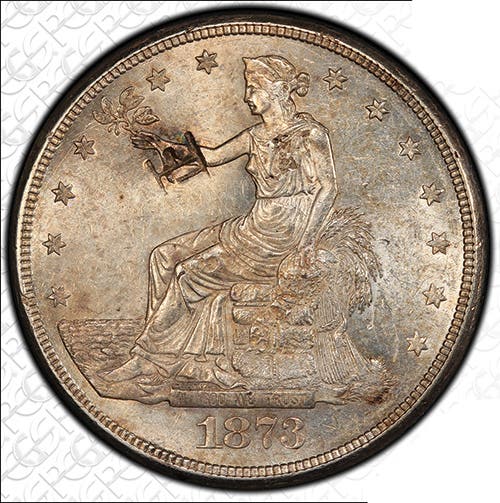
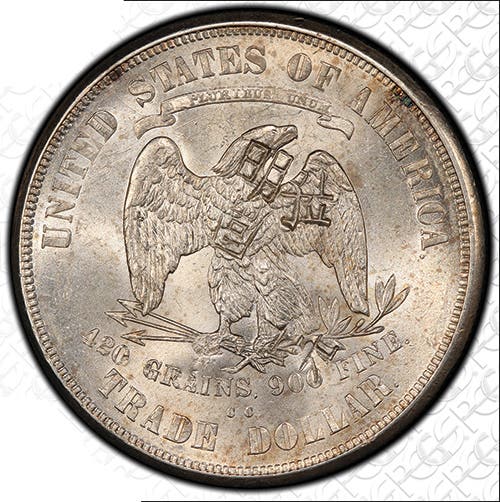
Above: An 1873-CC Trade dollar “Chop Mark” graded AU58 from the David Reimer PCGS Registry Collection of finest chop-marked Trade Dollars. Reimer writes, “With a mintage of only 124,500, the 1873-CC is one of the keys to the series, chop marked or not.” (Photo courtesy PCGS Registry Sets.)
Production of the Trade dollar overlapped that of the last issue of the Seated Liberty dollar (1873). The mintage was a substantial 124,500 at Carson City for the inaugural year of the Trade dollar. Bowers writes, “Nearly all coins were shipped to the Orient…. Many of the exported pieces saw heavy use and were chop marked…” David Reimer, who possesses the #1 PCGS Registry Set of Chop-marked Trade Dollars, writes, “With a mintage of only 124,500, the 1873-CC is one of the keys to the series, chop marked or not.” It is very rare with chop marks, for PCGS has only graded 17 examples carrying them. The finest chopped example is AU58. How rare is the 1873-CC Trade dollar? Maurice Rosen wrote in 1992, “This is a largely unheralded date, much rarer than the 1889-CC Morgan silver dollar.” It is impossible to determine the number of chop-marked Trade dollars authenticated and graded by NGC, for unlike PCGS, they consider them damaged and are counted among “Details” graded coins.
Graded coins:
PCGS (original) 102 (details)?
NGC (original) 33 (details) 61
1874-CC Trade Dollar
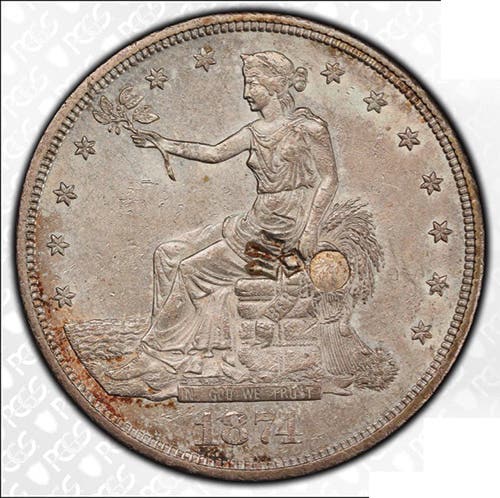
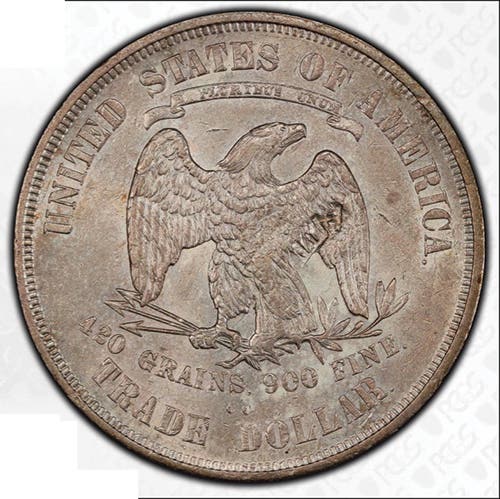
Above: The most common Trade dollar with chop marks is the 1874-CC. This one is graded PCGS AU-55 Chop Mark (CAC), from a private collection. (Photo courtesy of PCGS.)
The mintage of Trade dollars in Carson City was ramped up to 1,373,200 in 1874, pointing to the great success of the coin in China. Ron Guth writes in PCGS Coinfacts, “The 1874-CC is among the more common of the chop-marked Trade Dollars, and it also has one of the highest rankings in the Condition Census, with [three] examples at the MS64 level.” Writes Bowers, “Chop marked 1874-CC dollars are aplenty and always have been. The issue ranks as the most available of all chop-marked Carson City trade dollars…” PCGS has graded 151 examples with chop marks.
Graded coins:
PCGS (original) 618 (details)?
NGC (original) 295 (details) 325
1875-CC Trade Dollar
Above: Chinese accountants photographed by Lai Afong, circa 1880. (Photo courtesy of Wikimedia Commons.)
Writes Bowers, “With a total production quantity of 1,573,700 coins, the 1875-CC was produced in larger numbers than any other trade dollar from this mint.” The vast majority of the 1875-CC was exported to China. Bowers reports that the 1875-CC is the “most available CC trade dollar.” NGC Coin Explorer reports, “Carson City’s production of trade dollars was a replay of 1874, though the 1875-CC edition has survived in greater numbers.” Chop-marked examples are available, for PCGS has graded 131 of them. The finest with chops at PCGS is MS63.
Graded coins:
PCGS (original) 864 (details)?
NGC (original) 406 (details) 618
1876-CC Trade Dollar
The mintage in Carson City that year was 509,000. NGC Coin Explorer writes, “It’s not [known] why trade dollar production was suspended for the year after April, leaving the 1876-CC issue with just a third the mintage of 1875….This is the most difficult CC trade dollar to locate in high grades.” The mintage may have been lowered in Carson City because production greatly increased in San Francisco. In 1875, the mintage at the California mint reached 4,487,000, while in 1876, it was 5,227,000. Also, since the intrinsic value of the Trade dollar dipped below a dollar that year, unscrupulous silver merchants were distributing significant amounts of them domestically at par. The value of the coin dipped to 83 cents on July 22, the same day Congress removed the Trade dollar's legal tender status. Only 34 examples of the 1876-CC with chop marks have been graded by PCGS. The finest chopped example at PCGS is MS63.
Graded coins:
PCGS (original) 369 (details)?
NGC (original) 214 (details) 235
1877-CC Trade Dollar
Production of Trade dollars in Carson City resumed in June of 1877 and continued until the end of August. The total mintage for the year was 534,000. Allegedly, all those coins were earmarked for the China trade, the intended purpose of the Trade dollar. And many of them ended up in East Asia. However, as had happened in 1876, silver merchants were distributing undervalued Trade dollars at par. That was despite their legal tender status being revoked the year before. There have been 52 chopped examples of this issue graded by PCGS. The highest grade with chop marks is MS63.
Graded coins:
PCGS (original) 337 (details)?
NGC (original) 166 (details) 154
1878-CC Trade Dollar
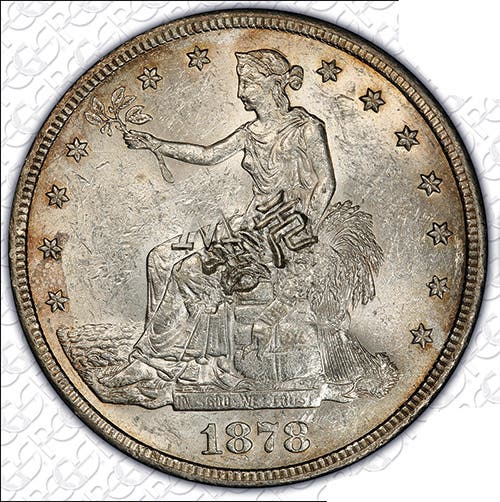
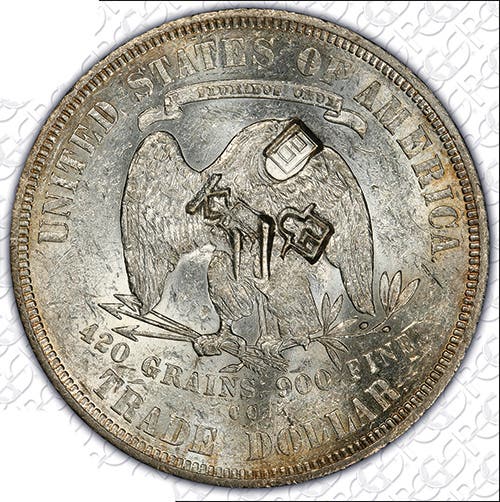
Above: Extremely rare 1878-CC Trade dollar with chop marks graded PCGS AU58 Chop Mark. From the David Reimer PCGS Registry Collection of finest chop-marked Trade Dollars. (Photo courtesy of PCGS Registry Sets.)
“By all accounts the 1878-CC is the most popular rarity among circulation strike trade dollars,” reports David Bowers.
David Hall writes, “This is an incredibly underrated coin in all grades. Long-time coin dealer Jack Beymer … says he has handled more 1794 dollars than 1878-CC trade dollars. That’s an incredible statement and shows how truly rare this coin is in any grade.” Early 1878 saw the Carson City Mint strike 97,000 pieces in anticipation of continued demand. However, just a portion of them were committed to merchants who deposited silver. Those not committed, according to NGC Coin Explorer, totaling 44,148 coins, were melted on July 19, leaving a net mintage of 52,852 pieces. We don’t know how many of the 52,852 1878-CC Trade dollars were shipped off to China. The evidence says a sizable amount circulated domestically.
John M. Willem, who authored the only book devoted to the U.S. Trade dollar, writes, “It is extremely difficult to find an 1878-CC with a genuine Chinese chop mark. It is the author’s considered opinion that a chop marked 1878-CC is the rarest of the trade dollars in any condition.” PCGS has graded only 8 examples with chop marks. The finest known is MS62. As discussed, we cannot determine how many 1878-CC coins with chops are graded by NGC because they are counted among the damaged coins in their “Details” census. Perhaps it is time for NGC to finally give chop-marked Trade dollars a straight grade “because of the frequency with which they occur and because of high demand from collectors.”
Graded coins:
PCGS (original) 253 (details)?
NGC (original) 107 (details) 115
Precious and few
Above: A commercial street in Canton, circa 1880. Merchants in Canton chop-marked Seated Liberty and Trade dollars that entered the Chinese economy. (Photo by Lai Afong, courtesy of Wikimedia Commons.)
The rarity of the four Carson City Seated Liberty dollars discussed in this article can be attributed to two factors: low mintages and the China trade. The low survival rates of the four issues suggest that merchants employed these de facto bullion coins for export. More evidence pointing to the use of the Seated Liberty dollar in the China trade concerns the Mexican dollar. The vast majority of silver exports from the U.S. to China for many years were Mexican dollars. However, starting in 1867, the Mexican government added a 12 percent excise tax on all silver coins being exported. Therefore, U.S. silver merchants stopped using Mexican dollars completely and employed more of the Seated Liberty dollars for export. That included Carson City dollars. Explaining the rarity of the Carson City Trade dollars is a bit more complicated.
Their rarity is due to two factors: the China trade and extensive melting. In total, there were 35,958,460 business-strike Trade dollars produced at the Philadelphia, Carson City, and San Francisco Mints from 1873 to 1878. Of those, there were 6,607,632 that remained in the U.S. However, after the coin was terminated in February of 1878, agitation began with the goal of redemption of Trade dollars at par, even though the price of silver was dropping. To that end, between the years 1879 and 1881, there were 2,074,812 Trade dollars repatriated from East Asia.
Nevertheless, in 1883, the U.S. government made it crystal clear that if and when Trade dollars would be redeemed, any that were chop-marked or otherwise mutilated would not be accepted. That news resulted in the re-exportation of 1,652,938 chop-marked Trade dollars to the East during the years 1884 to 1886. The total number of Trade dollars redeemed at par in 1887 was 7,689,036, most of which were eventually melted down. That figure represents 21.38 percent of all business strike Trade dollars.
The total amount of coins that did not return to the U.S. was 28,928,954. Of course, chop-marked and non-chopped Trade dollars have been returning from China since the 1940s-1950s for the collector market. This will help explain the rarity of Carson City (and other) Trade dollars.
Acknowledgment: The author wishes to thank Tom Rigione for his assistance in preparing this article for publication.
Sources:
Q. David Bowers, Silver Dollars & Trade Dollars of the United States - A Complete Encyclopedia. Internet version of the book via PCGS.
Eric Brothers. “International Sensation, Domestic Flop: The American Trade Dollar.” ANS Magazine, no. 2, (2023).
NGC Coin Explorer (Seated Liberty dollars from 1870-1873; Trade dollars from 1873-1878).
PCGS Coinfacts (Seated Liberty dollars from 1870-1873; Trade dollars from 1873-1878).
“Mineral Products. No. 668. Silver: Price and Value of Silver in the Dollar. 1925.” via Federal Reserve Bank of St. Louis.
You may also like: