France Repatriates Gold Reserves from New York Fed
Banque de France completes the shift of its gold reserves from New York to Paris while updating holdings to meet modern international standards.
For decades, many foreign central banks have stored some of their gold reserves in the vaults of the Federal Reserve Bank of New York. This was done to facilitate the settlement of international gold transactions. If one central bank were transferring gold to another central bank, the bars would not themselves move. Instead, the title of particular bars would be reclassified.
Before the rise of the Federal Reserve Bank, central banks mostly used the Bank of England and, to a lesser degree, France’s Banque de France or Swiss banks for the purpose of settling international gold transactions.
At the end of March, the Banque de France, that nation’s central bank, announced it had completed the repatriation of its final 129 tons (4.147 million ounces) of gold reserves that had been held in the vaults of the Federal Reserve Bank of New York.
The Banque sold the gold at the New York Fed vaults over 26 transactions from July 2025 through January 2026. As the gold was sold, the Banque purchased offsetting amounts of physical gold in European markets that are now in the Banque’s Paris vaults.
Since 2005, the Banque de France has been upgrading older gold bars in its reserves that no longer met modern international standards for weight and purity. Although this upgrade could have been accomplished by melting and refining the old bars, for this latest round of actions, the Banque simply sold off the bars in the New York Fed vaults and replaced them with purchases of bars compliant with current European market standards. As part of the late March announcement, the Banque announced that it expected to complete the updating of the rest of the gold bars in its vaults by the end of 2028.
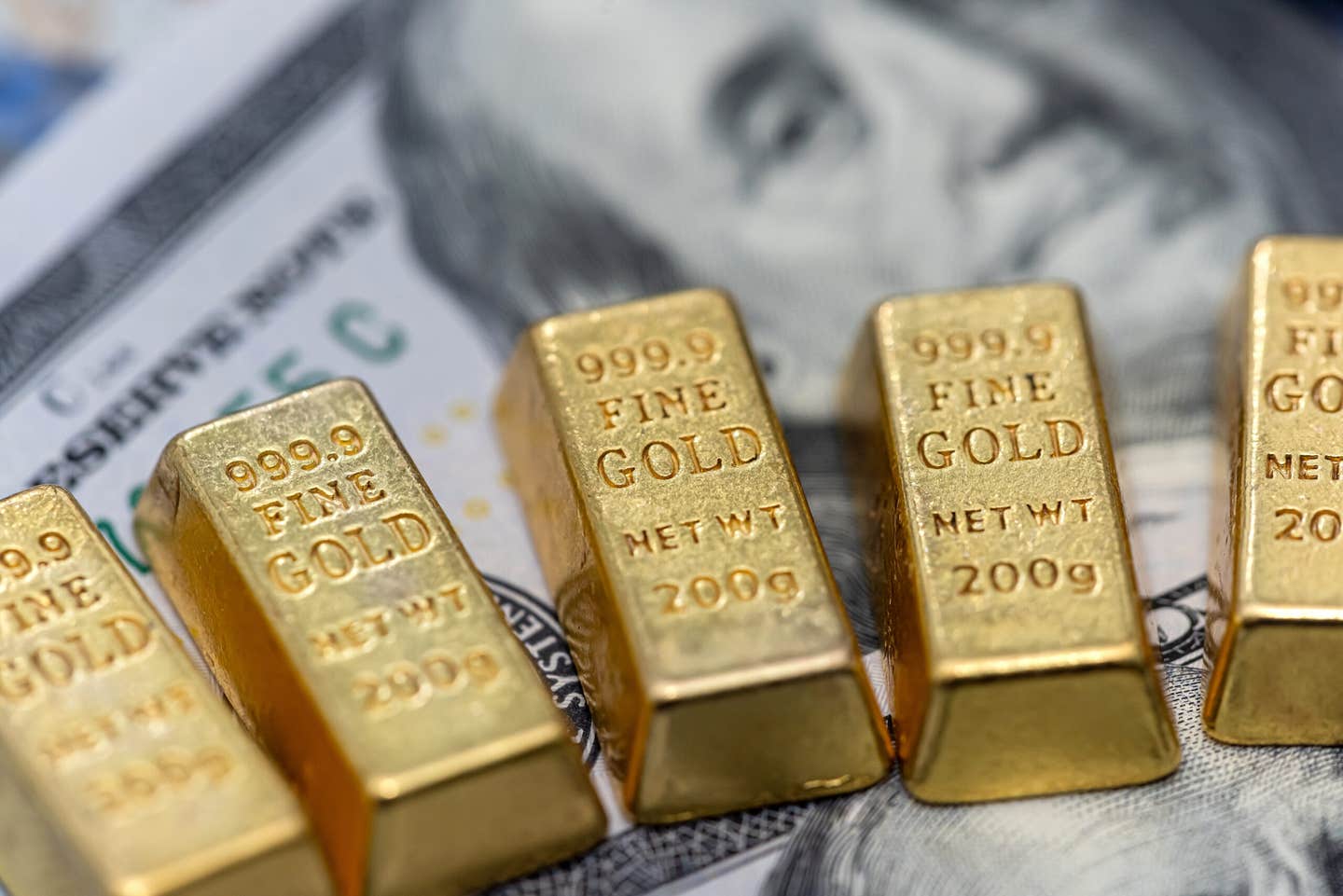
The specifications for gold bars traded on the London Bullion Market Association (LBMA) are that the gold purity must be at least 99.5 percent, the gross weight be a minimum of 350 troy ounces and a maximum of 430 troy ounces, have a length on the top of 210-290 millimeters, a width at the top of 55-85 millimeters, and a height of 25-45 millimeters. The bars must also bear a refiner’s mark, serial number, statement of fineness, and the year of manufacture. One-kilogram bars are also accepted by the LBMA, though they must be at least 99.99 percent purity.
The specifications for gold bars traded on the New York COMEX, where the most popular commodity futures contract is 100 ounces, either one kilogram (which must be 99.99 percent minimum purity), 100-ounce, or 400-ounce bars are acceptable. For the 100- and 400-ounce bars, minimum gold purity is 99.5 percent, weight may range from 95 to 105 troy ounces (for the 100-ounce bars), the bars must meet strict requirements for size, and be marked with a serial number, refiner’s brand, and purity and weight markings.
There is speculation that at least some of the 400-ounce gold bars held by the U.S. government at Fort Knox, the West Point Mint, and elsewhere may simply be of 90 percent purity, cast from the U.S. gold coins melted down in the mid-1930s. If so, such bars would not be deliverable on a gold exchange. Instead, they would have to be melted and refined to minimum purity standards and marked as required.
Similar product specifications also apply at the LBMA and COMEX for other precious metals contracts that they trade.
Last column’s numismatic trivia question.
Last time I asked— Which U.S. coins contain manganese as part of the alloy? To save copper for military usage, the U.S. Mint switched the nickel’s alloy partway through 1942 from 75 percent copper and 25 percent nickel to only 56 percent copper, 35 percent silver, and 9 percent manganese. Beginning in 1946, the Mint reverted to the original alloy. Starting in 2000, the Sacagawea/Native American, Presidential, and American Innovation Dollars had been struck from an alloy containing 77 percent copper, 12 percent zinc, 7 percent manganese, and 4 percent nickel.
This week’s trivia question
Here is this week’s question. In addition to gold, silver, platinum, copper, nickel, and zinc, what other materials were used at least once to strike U.S. Mint pattern coins? Come back next week for the answer.
Patrick A. Heller was honored as a 2019 FUN Numismatic Ambassador. He is also the recipient of the American Numismatic Association 2018 Glenn Smedley Memorial Service Award, the 2017 Exemplary Service Award, the 2012 Harry Forman National Dealer of the Year Award, and the 2008 Presidential Award. Over the years, he has also been honored by the Numismatic Literary Guild, Professional Numismatists Guild, National Coin & Bullion Association, and the Michigan State Numismatic Society. He is the communications officer of Liberty Coin Service in Lansing, Michigan, and writes “Liberty’s Outlook,” a quarterly newsletter on rare coins and precious metals subjects. He now volunteers with the National Coin & Bullion Association as its Industry Issues Advisor. Past newsletter issues can be viewed at www.libertycoinservice.com. Some of his radio commentaries, "Things You ‘Know’ That Just Aren’t So,” and “Important News You Need To Know,” can be heard at 8:45 a.m. Wednesday and Friday mornings on 1320-AM WILS in Lansing (which streams live and becomes part of the audio archives posted at www.1320wils.com).
You may also like: