
Item of the Week: 1860-O turns out not to be a dime a dozen
Low mintage, Civil War-era history, and elusive high-grade survivors make the 1860-O dime a compelling and underrated collector coin.
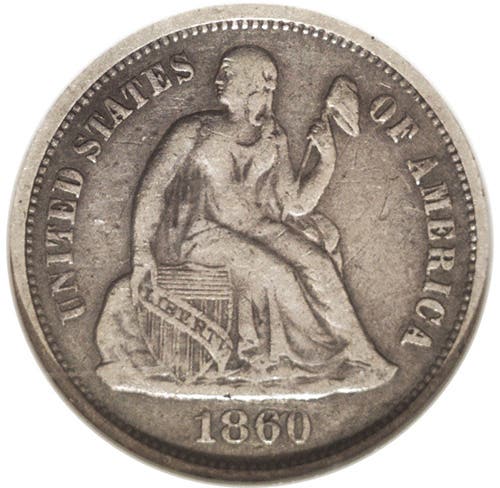
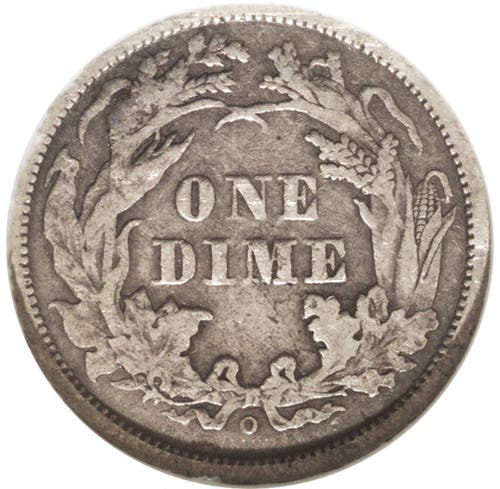
Some coins you have to like at almost any price. The 1860-O dime might well be one of those coins, for it has a great deal to offer, and while not cheap, it could be much more expensive.
The U.S. in 1860 was in turmoil, and civil war was on the horizon. People were nervous, but for a short time, it was business as usual. leave with half dollars or dimes. New Orleans did not always have heavy production levels, however. Even if New Orleans did produce a large number of one date, there were not significant numbers of collectors in the area to save nice examples. Moreover, most of the collectors of the day were only concerned that their collections had the specific date. If they wanted an 1860 dime, they were happy if they obtained a proof from Philadelphia. Examples from other mints were not required. The collecting patterns of the time are the reason why proof examples today are far more available than top-quality uncirculated examples. People got their proofs and took pains to keep them in their original condition. Business strikes were simply obtained and used in circulation. That does not really apply to the 1860-O, as it was not available as a proof, but the Philadelphia proofs were adequate for most who did not seek an 1860 dime from New Orleans.
Even if you had wanted an 1860-O, it would not have been easy to obtain one unless you happened to live in or around New Orleans. Part of the problem would have been simple logistics – there was a port of New Orleans, which meant the city’s branch mint continued to produce coins. New Orleans established itself in a relatively short period as the nation’s second mint. It had been part of the legislative package that created facilities in Charlotte, N.C., Dahlonega, Ga., and New Orleans.
But Dahlonega and Charlotte had been created to service the gold fields and were not true full-service facilities. New Orleans was more along the lines of the main Philadelphia Mint. A person could bring silver into New Orleans, and there was no way to acquire a 1860-O except to show up at the door. With the Civil War looming, a quick jaunt to New Orleans was not a top priority for many.
Even if you did manage to show up, getting an 1860-O would not have been a certainty. Its mintage that year was not high, with only 40,000 being produced. Back in 1860, a mintage of 40,000 was not considered low. The 1858-S dime had a mintage of 60,000; the 1863 14,000; the 1864 11,000; the 1865 10,000; and the 1866 8,000. The 1860- O did not stand out as a rare dime.
The 1860-O also stood out because it was the first to feature the new obverse. All dimes produced at New Orleans had the legend, not stars, on the obverse. The 1860-O was also the last dime produced in New Orleans until 1891.
An 1860-O today is priced at $300 in G-4. Its price rises to $6,000 in MS-60. The MS-60 price may be low for the simple reason that the 1860-O is extremely rare in top grades. It has no price listing in any grade above MS-60, and that alone suggests that if even an MS-60 appears on the market, it is likely to be grabbed quickly at any price.
The 1860-O is likable even in lower grades. It’s a coin more than 140 years old with low mintage. It was released in a port town shortly before the Civil War broke out. Its scarcity, history, and pricing make for a good collecting recipe.