
Why Are Some Private/Territorial Gold Issues So Rare?
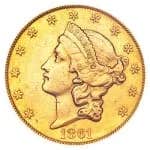
Some private gold coins failed because they contained too little gold. Today, that failure can make them exceptionally rare.
In America’s history, there have been a number of gold issues for use as a medium of exchange that were not struck by the U.S. government. They were manufactured in Georgia, North Carolina, California, Oregon, Utah, and Colorado. Pretty much all of them were produced in quantities much lower than the issues coming out of the U.S. Mint.
The legality of private coin issues ended during the Civil War, although banks in North Carolina accepted deposits of Bechtler pieces at full face value up into the early 20th Century.
Consequently, it is not surprising that most of these issues, outside of most California Fractional Gold pieces, are today great rarities treasured by collectors. In some instances, so few pieces were struck that surviving specimens are exceedingly scarce today.
Still, there were other issues that seem to be much scarcer than indicated by how many pieces were struck. There is a sensible explanation for at least some of this rarity.
When private gold issues entered the market, they were not automatically accepted at face value. To compete with U.S. Mint issues, they needed the same gold content. It turns out that several of the private issues matched U.S. coinage for weight, but the gold purity was lower than Mint standards.
When a new private issuer started putting their products into circulation, competitors quickly tested samples to check if the gold content met U.S. government standards. News spread quickly when a manufacturer was found to include a substandard amount of gold in their pieces. As a result, the public was fairly fast in refusing to accept such coins.
Therefore, substandard quality private and territorial gold issues tended to have lower mintages, with a sizeable percentage going into the melting pot at the time.
The result is that good quality private issues such as from the Betchlers, Moffat, Kellogg, and Clark Gruber today tend to be more readily available and more affordable. It is the lightweight issues by the charlatans or incompetent fabricators that are often now much scarcer and more valuable.
It may not seem fair that the substandard issues would today often be more valuable than those that contained full gold content, but it is understandable.
Last column’s numismatic trivia question.
Last time I asked, How long have gold and silver been used as a medium of exchange? The use of gold and silver as a medium of exchange goes back further than when the first coins were struck in the Greek Kingdom of Lydia in the 7th Century B.C. By 1500 B.C., the Egyptians and other nearby lands were using gold rings as a medium of exchange. However, there are some indications that gold traded because of its weight not long after the first gold jewelry was created about 3600 B.C. Silver appears to have begun trading on the basis of its weight around 2000 B.C.
This column’s trivia question.
Here is this column’s question. How is the U.S. Dollar Index calculated? Come back next week for the answer.
Patrick A. Heller was honored as a 2019 FUN Numismatic Ambassador. He is also the recipient of the American Numismatic Association 2018 Glenn Smedley Memorial Service Award, the 2017 Exemplary Service Award, the 2012 Harry Forman National Dealer of the Year Award, and the 2008 Presidential Award. Over the years, he has also been honored by the Numismatic Literary Guild, Professional Numismatists Guild, National Coin & Bullion Association, and the Michigan State Numismatic Society. He is the communications officer of Liberty Coin Service in Lansing, Michigan, and writes “Liberty’s Outlook,” a quarterly newsletter on rare coins and precious metals subjects. He now volunteers with the National Coin & Bullion Association as its Industry Issues Advisor. Past newsletter issues can be viewed at www.libertycoinservice.com. Some of his radio commentaries, "Things You ‘Know’ That Just Aren’t So,” and “Important News You Need To Know,” can be heard at 8:45 a.m. Wednesday and Friday mornings on 1320-AM WILS in Lansing (which streams live and becomes part of the audio archives posted at www.1320wils.com).
Find a hodgepodge of Heller below:


